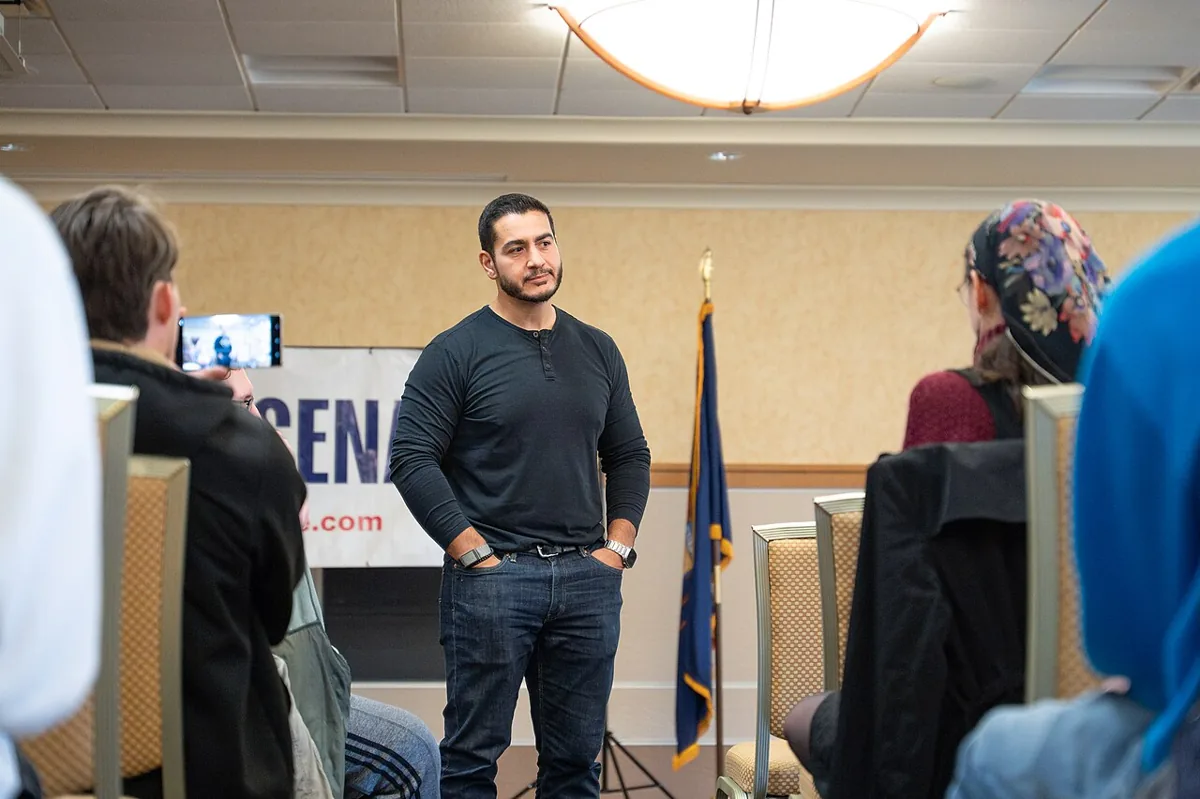
Days before Election Day, with a Senate seat on the line, the Democratic nominee in Michigan has asked his own primary-opponent-turned-endorser to stay home from a campaign event at a Detroit church. The fight is over an ad that neither of them made. Somewhere, a Republican strategist is staring at this story the way a starving man stares at a buffet.
The Setup: An Endorsement With a Condition Attached
According to Politico's reporting, El-Sayed's campaign requested that Haley Stevens not attend a Sunday event beside him, citing two people familiar with the decision. Stevens, remember, is the woman he beat in the Michigan Democratic Senate primary. She did what losing candidates are supposed to do. She endorsed the winner. She even appeared next to him at an event in August.
That is how a party is supposed to work. You fight, you lose, you shake hands, you hold the door open, and you spend the general election pointing at the other guy. It is not complicated. It is practically the only trick the Democratic Party knows.
The Ad Nobody on Stage Made
Here's where it fell apart. Stevens made it clear that her planned appearance at the Detroit church had a precondition. El-Sayed would have to denounce an ad from an outside group that attributes rising costs to US support of Israel.
An outside group. Not his campaign. Not his party. A group that, by the standard rules of modern campaign finance, he is not supposed to be coordinating with and generally cannot control. The ask was to publicly disown someone else's ad as the price of showing up to an event she had already endorsed him for.
El-Sayed Said No, and Things Got Ugly Fast
El-Sayed refused. He accused Stevens of reopening a settled primary race, and honestly, you can see his point. The primary is over. He won it. The thing that divided them most fiercely, US support for Israel, was the main event of that fight, and here it was, back from the dead and wearing a church suit.
From there, relations soured. By Saturday morning, nobody could say whether Stevens would attend the event even if she were invited. Which is a remarkable sentence to write about two people on the same ticket, on the same side, nine days before a general election.
Why This Is a Gift to the Other Side
Let's be clear about what a Senate race is. It is a contest against the opposing party, in which the one thing you cannot do is hand them a week of coverage about your own infighting. This is that week of coverage. A story about an endorsement collapsing over an Israel ad is the exact story the Republican nominee's team would write themselves if they had the creativity, which they won't need, because the Democrats just did it for them.
And the timing could not be worse. The final stretch of a campaign is supposed to be about the closing message. Instead, the closing message in Michigan is about who owes whom a denunciation.
Both of Them Had a Point, Which Is the Problem
Stevens has a real position and a real constituency, and demanding a distancing from an ad she finds objectionable is not insane. El-Sayed has a real position too, and refusing to let a defeated rival dictate terms from the sidelines is not insane either. Reasonable people can land on either side of that argument.
But reasonable people can also look at the calendar. The Israel debate in the Democratic Party is genuine, it is bitter, and it is not going to be resolved at a Detroit church on a Sunday. It was always going to be resolved after the votes were counted. That was the deal. That was the whole point of endorsing.
The Dingo Take
Win the primary, lose the endorsement. That's the state of Michigan Democrats nine days out.
The party spent months telling voters this election matters, that the stakes are enormous, that the other side is a threat. Then two people who agree on roughly ninety percent of the stakes managed to turn a church event into a hostage negotiation over an ad neither of them paid for. If the Senate majority comes down to a few thousand votes in Michigan, somebody is going to have to explain this week to a very tired room.
Here's the thing. You don't have to agree on Israel to stand next to each other. You just have to want the other guy to lose more than you want to win the argument. That is the whole job. Stevens signed up for it when she endorsed, El-Sayed signed up for it when he won, and both of them just proved the primary never actually ended. It only changed venues.





Comments