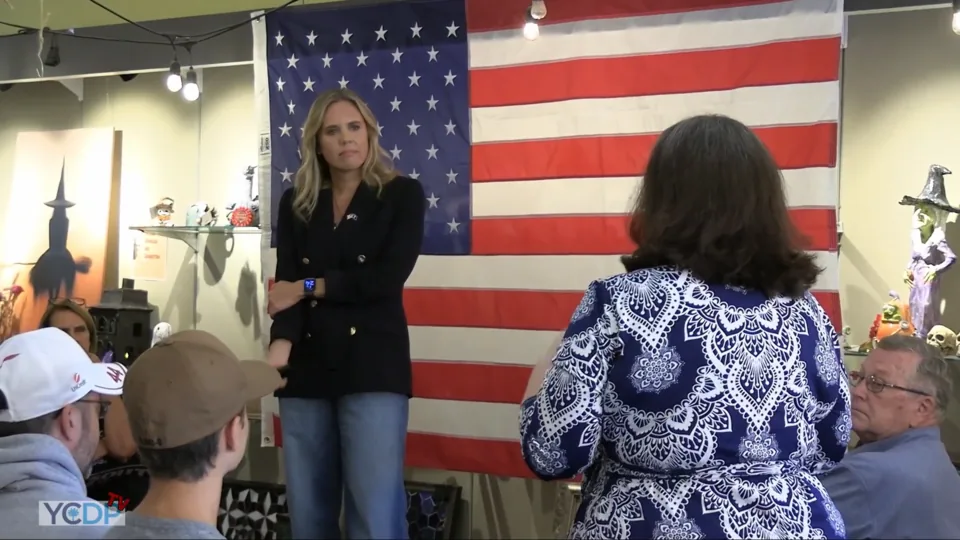
A pediatrician just won Lindsey Graham's old Senate seat in a state Donald Trump carried by nearly 18 points. She beat his sister, a woman who ran the state Commission for the Blind until she was handed a Senate seat and who told a debate audience that national security "is not my thing."
A Seat Republicans Had Held Since 1998
Democrat Annie Andrews has defeated Republican Sen. Darline Graham in South Carolina, according to race calls from the Associated Press and CBS News. Andrews is the first Democrat to win a Senate race in the state since 1998. She is also the first woman South Carolina has ever elected to the Senate.
The Guardian reported that the last New York Times/Siena poll before Election Day had the two women tied at 48 percent apiece. That is a dead heat in a state Trump won by roughly 18 points in 2024. Nobody who understands South Carolina politics expected the race to look like that, and it ended up being even closer to the Democrats' side of the ledger than the tie suggested.
NPR called it a stunning upset and a critical pickup for Democrats, who need a net gain of four seats to take the Senate majority.
How Darline Graham Got the Job
Lindsey Graham died suddenly on July 11 at age 71. Gov. Henry McMaster appointed his sister, Darline, to fill the seat. She is 62, and she had spent nearly 30 years in obscure state government roles, most recently as head of the South Carolina Commission for the Blind.
She then won a condensed special primary in August to claim a spot on the November ballot. That primary is where she gave the quote that followed her for the rest of the campaign. Asked about U.S. policy on Taiwan, she admitted she was "not that informed on national security." In a separate debate exchange, she put it more bluntly: "National security is not my thing."
This is the sister of a man who spent decades as one of the loudest voices on foreign policy in the Republican Party. The family business was national security. Darline looked at the family business and said, thanks, but no. Then she ran for the seat anyway, in the middle of a war with Iran.
Trump Showed Up. So Did the Money.
Trump urged Graham to run, endorsed her in the special primary, and campaigned for her in the final stretch. The Guardian reported that he also referred to Andrews using a transphobic slur. The president praised Lindsey Graham's legacy while telling voters to back his sister, which turned the race into a referendum on his own pull in the state.
The cash followed. CBS News reported that the Senate Leadership Fund, the main Republican super PAC, dropped $5 million into the race in October. MAGA Inc., the super PAC controlled by Trump, gave Graham another $827,000 in August. The New York Post noted that outside Republican groups poured in millions to shore up a race that was getting away from them, even as GOP operatives whispered anonymously about the candidate's shortcomings.
Millions of dollars, a presidential campaign swing, and a family name that has won in South Carolina for decades. It wasn't enough.
The Candidate Who Brought Up Inhalers
Andrews is 45 and a pediatrician, and she built her campaign around a single question she says she heard from parents over and over in her exam room. "How much is that inhaler going to cost?" Or, "How much is that insulin going to cost?" She told NPR that no parent should have to think about their pocketbook while hearing that their child has a chronic illness.
That pitch ran straight through healthcare access, affordability, ending tax breaks for the wealthy, raising wages, and pushing for affordable child care. She also campaigned against corruption in Washington. And she called the war with Iran "illegal" and "unconstitutional," criticizing a billion-dollar-a-day price tag and its effect on gas prices.
The war with Iran is deeply unpopular with a majority of Americans. Graham said she fully trusted Trump on tariffs and the war. NPR reported that Trump's approval ratings hit record lows in the weeks before the midterms, driven largely by opposition to the war, his tariff policies, and high energy prices. Graham tied herself to all three.
Not Everyone Is Cheering Every Line
We aren't going to pretend Andrews ran a flawless campaign, because she didn't. She tried to separate herself from other Democrats on several issues, and she took real criticism from LGBTQ+ advocates for a late ad. In it she referred to trans women as "biological men" and said she doesn't support gender surgery for minors.
That is a sharp turn from 2022, when Andrews called South Carolina's Save Women's Sports Act "actively harmful" and wrote on X, "I will always support trans youth." Politicians reposition in swing states and red states. It happens. It is still worth saying out loud that trans kids were part of the price of admission in this race, and that the people who objected have a point.
The broader result lands in a pattern. In North Carolina, former Gov. Roy Cooper beat Michael Whatley, the former RNC chairman Trump hand-picked, to flip the seat Thom Tillis is leaving. NPR noted the favorable environment expanded the Democratic map to include red-state seats in Kansas and Texas too.
The Dingo Take
Start with the parents who sat across from Annie Andrews in an exam room and asked what an inhaler was going to cost. Those are the voters who just handed a Senate seat to a pediatrician. They did not need a poll to tell them prices were up, a war was draining the budget, and the party in charge kept talking about everything except their kitchen table.
Now look at what the other side offered. A seat handed over after a death, a nominee who said national security was not her thing during a war, and a president who responded by showing up with a slur and a super PAC. Republicans threw more than $5.8 million at this thing and still lost. You cannot buy your way out of a record-low approval rating and a war the majority of the country hates. They tried anyway.
Here's the part Democrats should tattoo somewhere visible: Andrews won by talking about costs and caring about people who couldn't afford to get sick. She also tacked right on trans issues in the final month, and that deserves honest scrutiny, not a victory-lap pass. The winning message was affordability. The thing worth arguing about on the way up the ladder is who gets left behind to make the math work.


Comments