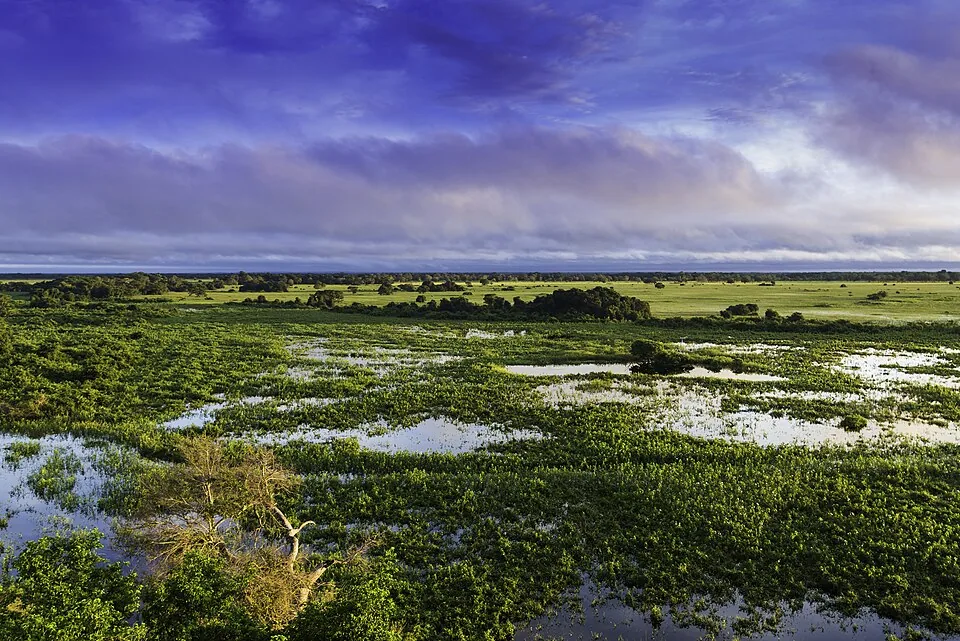
A government somewhere on Earth just did a thing to protect nature, on purpose, in the open, and the planet's largest flooded grassland is better off for it. Brazil expanded Pantanal Matogrossense National Park by 185 square miles, a jump of more than 25 percent, in the home territory of the largest concentration of jaguars anywhere on the globe.
Redwoods National Park, But Make It Swamp
Here's the math, courtesy of Good News Network. Pantanal Matogrossense National Park used to cover 523 square miles. Brazilian environmental authorities just tacked on another 185. That's roughly the equivalent of bolting America's Redwoods National Park onto the existing footprint.
A quarter of the original size might sound modest if you're used to land announcements that arrive with a ribbon and a golf course. It isn't. In conservation terms, a 25 percent expansion of a protected core is a big deal, especially when the thing being protected is as hard to replace as this.
The Most Animals You Will Ever See in One Wetland
The Pantanal is the world's largest flooded grassland, and the species list reads like someone lost a bet with a zoo. There are 463 species of birds, 269 species of fish, more than 100 species of reptiles and amphibians, and over 236 species of mammals.
The mammal roster includes the tapir, the giant otter, the giant armadillo, and the giant anteater. Nobody was feeling creative with the naming. It also includes the largest concentration of jaguars on Earth, which is the kind of fact that should end any argument about whether this place is worth defending.
The reporting describes the Pantanal as "one of the richest and most sensitive biomes on the planet." Sensitive is the operative word. This ecosystem runs on water, and water is exactly what a warming, burning, drought-prone planet keeps taking away.
Experts Asked For This and Got It
Brazilian outlet Fato Paulista described the expansion as meeting a long-standing demand from experts and environmentalists, who had pushed for greater protection of critical breeding areas for many of these animals.
Read that again. Experts asked for something, and it happened. No decade of hearings, no industry-funded study concluding that a jaguar is a social construct. Credit where it's due: the people who study this place said what it needed, and the government listened.
The park is administered by the Chico Mendes Institute for Biodiversity Conservation, known as ICMBio. The agency identified the key biological corridors that wildlife use to move in and out of the protected area, and the expansion is built around those routes.
Corridors Are the Whole Ballgame
A park boundary is a line on a map. Animals don't read maps. Jaguars, tapirs, and anteaters move where food, water, and mates are, and a protected zone that traps them inside a fixed rectangle eventually becomes a very pretty genetic dead end.
That's why the corridors matter so much. They keep populations connected, which keeps gene pools diverse, which is particularly important for endangered species living inside the park. Inbreeding is not a flaw of the animals. It's a flaw of fencing nature into postage stamps.
Keeping those corridors open requires consultation and cooperation with local landowners. That's the hard part, and it's the part to watch. Cooperation with ranchers and farmers is easy to announce and tough to sustain. A corridor is only as protected as the least cooperative property along it.
Thirty-Three Years of a Promise Slowly Kept
Pantanal Matogrossense was designated a wetland of international importance under the United Nations' Ramsar Convention 33 years ago. The expansion follows the spirit of that convention, which is the principle that wetlands of this caliber deserve real, expanding protection rather than a plaque.
The pressure on the region hasn't eased. Fires and droughts keep threatening its integrity. Protecting the rivers that feed the Pantanal helps the land hold onto its characteristic sponginess, the water-retaining quality that makes the whole system resilient. A sponge that stays wet is a sponge that doesn't burn.
The Dingo Take
The official framing here is the gentle one: a quiet expansion, a spirit-of-the-convention gesture, a nice item for the good news pile. The facts show something more pointed. Fires and droughts are actively threatening this wetland, and the Pantanal's survival depends on protecting the rivers upstream, not just the acreage inside the fence. A bigger park is a start. It is not the finish line, and nobody involved claims it is.
Still, give it its due, because the bar is on the floor and this clears it. Experts asked for more protection of breeding grounds. The agency in charge mapped the corridors animals actually use. The park grew by the size of Redwoods National Park. In a news cycle where governments mostly announce new ways to drill, pave, and subsidize extinction, a country widening the safety zone around the planet's densest jaguar population is almost suspiciously sane.
Here's the part to keep your eye on. The expansion lives or dies on cooperation with local landowners, and a corridor that exists on paper but not on the ground protects nothing. If Brazil follows through, this is a genuine win for one of the most irreplaceable places on Earth. If it doesn't, the jaguars will be the first to know, and they won't be filing a press release.





Comments