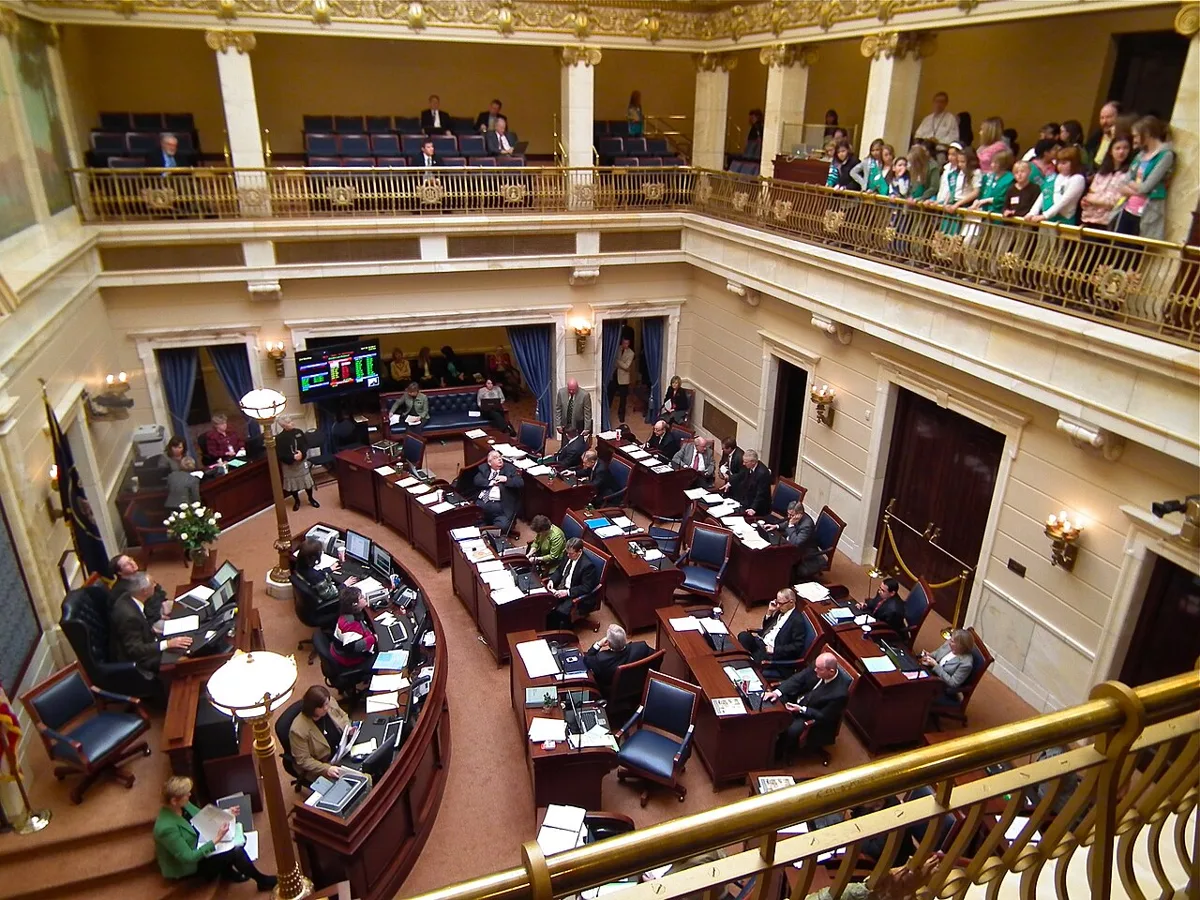
In one of the reddest states in America, Republican congressional candidates have apparently decided that the best thing to do with Donald Trump's name is leave it on the shelf. Utah's 3rd Congressional District primary is shaping up as a preview of what the GOP might look like when it has to survive without Trump as a crutch — and the answer, at least in Utah, is complicated.
44% in Utah Is Basically a Disaster
Let's set the scene. Utah has not voted for a Democratic presidential candidate since Lyndon Johnson in 1964. It is, by almost any measure, a reliably conservative state. And yet, according to a Deseret News/Hinckley Institute of Politics poll from April, Trump's job approval in Utah has sunk to 44 percent — an all-time low for him there. Support among Utah Republicans specifically dropped 10 points.
NPR reports that Trump never cracked 60 percent of the vote in Utah even at the height of his electoral popularity, and Utahns gave him his smallest margin of victory out of any Republican state back in 2016. The Church of Jesus Christ of Latter-day Saints dominates the state's cultural identity, and Trump's comments about Islam and other religions have historically landed badly with a population that takes religious freedom seriously. So when a state that almost never votes Democratic starts cooling on you this hard, that's not a blip. That's a signal flare.
Chris Karpowitz, a political science professor at Brigham Young University, put it plainly to NPR: "There's many Republican voters in Utah who have sort of made their peace with Donald Trump enough to vote for him. But that doesn't mean they necessarily support either his style of politics or some of the policies that he pursues." Then the kicker: "They are loyal to the party, not the president."
Two Conservatives, Zero Trump References
Utah's newly redrawn 3rd Congressional District — a massive seat running from the northern part of the state all the way down to the Arizona border, covering all five national parks, Park City's ski slopes, BYU, and some of the fastest-growing communities in the country — is holding a Republican primary between incumbent Rep. Celeste Maloy and former state Rep. Phil Lyman. Per NPR, the Cook Political Report rates this as one of the reddest districts in the United States.
Both candidates support Trump. Neither is talking about him. That gap is the whole story.
Maloy is the establishment candidate, policy-focused and institutionally aligned. Lyman is Freedom Caucus-adjacent, America First in his rhetoric, and a man with a genuinely colorful backstory: Trump pardoned him during his first term after Lyman led an illegal ATV protest ride across protected federal land. He later aligned himself tightly with the MAGA movement in the Utah Legislature. Now he's running on limiting federal power, bolstering rural communities, and election transparency — and he's barely mentioning the man who kept him out of jail.
Lyman told NPR his pitch is existential: "What is at stake here is are we going to go down a collectivist technocratic, centralized power model, or are we going to retain an American independent individual autonomy." That's MAGA policy dressed in libertarian language, which is exactly what you do when MAGA branding is polling at 44 percent in your state.
Maloy's Thin Ice
Maloy, for her part, did not respond to NPR's multiple interview requests, which is a choice. She has had a rocky relationship with Utah Republican voters since she won a special election in 2023. In 2024, she lost at the Republican nominating convention, only surviving the cycle by narrowly winning the primary — by just over 200 votes. Trump endorsed her ahead of that election and it barely moved the needle.
That's the dynamic Lyman is trying to exploit. Maloy's vulnerability isn't ideological — she's plenty conservative — it's personal. Utah Republicans seem mildly allergic to her, and Lyman is betting that a race run on issues and her voting record will shake enough of her support loose. Whether that works is a question the primary will answer, but the fact that even the establishment incumbent isn't invoking Trump's name tells you everything about the room temperature in Utah right now.
Meanwhile, Trump Is Playing a Different Game Everywhere Else
Zoom out from Utah, and NPR has published a separate analysis of how Trump's endorsement strategy has transformed Republican primaries nationwide. The numbers are striking. In the 2018 midterms, the average Trump endorsement in a primary came about seven weeks before Election Day. In 2026, that number is closer to seven months. The endorsements are coming earlier, they're going more heavily to incumbents — nearly 75 percent of his endorsements this cycle back sitting members — and they're increasingly designed to clear the field before a serious primary challenge can even organize.
The strategy works. A lot. But it has misfired in some notable places this cycle. Trump endorsed Iowa Rep. Randy Feenstra for governor four days before the primary, and Feenstra narrowly lost. He backed Georgia Lt. Gov. Burt Jones nine months out from the state's gubernatorial primary, only to see Burt Jones lose this week in a runoff to billionaire health care executive Rick Jackson, according to NPR. In South Carolina, Trump's situation got awkward enough that he ended up endorsing both candidates in a gubernatorial runoff in the final days before the election, which is the political equivalent of texting two people "you're the one" at the same time and hoping for the best.
The Boilerplate Kingmaker
Part of what NPR's analysis reveals is just how formulaic Trump's endorsement machine has become. The language is almost copy-pasted between candidates. He'll champion farmers and ranchers, cut taxes and regulations, ensure energy dominance, keep the border secure, and the candidate will NEVER LET YOU DOWN. NPR published nearly identical endorsement posts for Arkansas Rep. Rick Crawford, Oklahoma Rep. Kevin Hern, and Ohio challenger Derek Merrin, all using the same capitalized phrases in roughly the same order.
This is less kingmaking and more brand licensing. Trump attaches his name to candidates who are already likely to win in safe seats, collects the loyalty, and calls it influence. When he takes genuine risks — backing long shots, wading into real competitive primaries late — the record is considerably spottier. The early-endorsement strategy is partly about projecting power and partly about protecting his win rate. You can't lose a race you got out in front of before anyone else jumped in.
The Dingo Take
Here's the thing about Utah: it's not a swing state going purple. These are still rock-ribbed conservatives who will almost certainly send another Republican to Congress. The story isn't that Utah is flipping. The story is that even in a state this red, in a primary this safe, Republican candidates are running away from the sitting president of their own party like he's a gas leak. That tells you something real about where the Republican Party lives right now, beneath the surface-level MAGA triumphalism.
What Karpowitz said at BYU is the line worth holding onto: "They are loyal to the party, not the president." That distinction is going to matter a lot in 2028 when Trump is constitutionally barred from running and the Republican Party has to figure out what it actually is without him on the ballot. Utah might genuinely be the preview. A deeply conservative electorate that tolerated Trump, benefited from Trump, but never fully bought what he was selling stylistically. The question is whether that version of conservatism has a future, or whether the Freedom Caucus wing has permanently rewritten the party's DNA.
As for Trump's endorsement machine turning into a boilerplate content farm that recycles the same 12 phrases for every candidate in every state regardless of context — that's a tell. Real political influence is specific. Real kingmakers know the room. When your endorsement of an Arkansas incumbent and your endorsement of an Ohio challenger read like the same Microsoft Word template with the name field swapped out, you're not shaping the Republican Party anymore. You're just putting your logo on it.

Comments