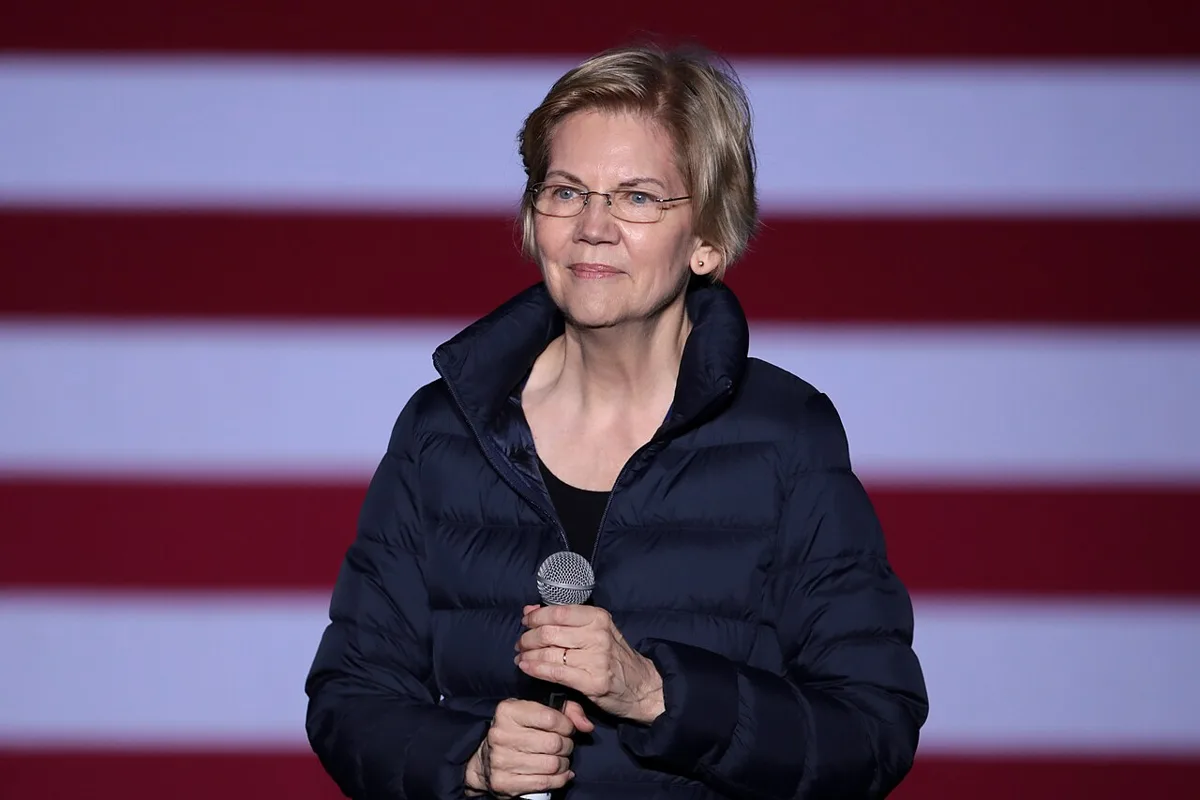
Elizabeth Warren wants every CEO who paid Trump's cover charge to get their deals blessed to know something: the clock is ticking. The Massachusetts senator is warning that the corporate merger spree the Trump administration has rubber-stamped could be unwound by the next administration, and that the companies now giddily consolidating their way to dominance may have badly miscalculated what's coming.
The Pay-to-Play Machine, Running at Full Speed
According to The Guardian, the Trump Justice Department approved the $111 billion merger of Warner Bros Discovery, parent of CNN and HBO, with Paramount Skydance, which includes CBS News, earlier this month. That is a staggering amount of money, and a staggering amount of news infrastructure, landing in the hands of the Ellison family, longtime Trump associates.
Warren did not mince words about what she thinks is driving this. "As soon as Trump took office, corporations came knocking at the White House door to get their pro-monopoly deals approved," she said in a speech to the Open Market Institute. "Have you wondered why companies keep donating millions of dollars to Trump's gold-encrusted ballroom, his arch, or his library? It looks a lot like a pay-to-play scheme."
It does look like that, yes. Quite a lot like that. The administration has also, per The Guardian, waved through Nippon Steel's $14.9 billion acquisition of US Steel, Omnicom's $13.5 billion grab of Interpublic to create the world's largest advertising agency, and a $35 billion merger between Capital One and Discover Financial. The deals keep coming. The donors keep showing up. The approvals keep flowing. Funny how that works.
Two of America's Biggest News Outlets, One Very Interested Family
The Warner-Paramount deal is the one that should make your stomach drop. Larry Ellison is a longtime Trump associate. His son David Ellison, after gaining control of CBS News through the earlier Paramount Skydance deal, appointed Bari Weiss as editor-in-chief of CBS News. Weiss is a conservative commentator with, as The Guardian notes, no previous television experience whatsoever. CBS News has since been hit with allegations of political bias, including at 60 Minutes, the most watched program in television news.
Now the Ellisons are in line to control CNN as well. Warren told The Guardian that combining the two networks under a single owner would mean "there's one ultimate decision-maker who decides what's important and what's not" at two of the country's largest news operations. She warned that Ellison "wants to inject a tilt into the news," meaning Americans turning to these outlets would increasingly hear "a predigested version of the world that is comfortable for the new management."
People inside CNN are already alarmed, according to The Guardian's reporting. And why wouldn't they be? The last major figure Ellison installed in a CBS News leadership role had never worked in television. The implication for what comes next at CNN is not subtle.
The Lawsuit That Hasn't Happened Yet
State attorneys general have reportedly been planning a lawsuit against the Warner-Paramount deal, but as of now they have not announced it. Warren told The Guardian she wouldn't read too much into the delay, citing the sheer logistical weight of taking on a billionaire with deep pockets and a friendly administration. Coordinating multiple states, pooling resources, building a case against someone of Ellison's scale takes time.
But time is the one thing these deals count on. The longer they sit, the more integrated the companies become, the harder any future unwind gets. That's not an accident. That's the strategy.
What Happens After 2028
Warren's core warning is simple and worth taking seriously: antitrust law allows for retroactive breakups of mergers if they are later found to violate those laws. She's not just venting. She's describing an actual legal mechanism. A future administration with a different set of priorities could look back at every deal cut during this period and ask whether it should still stand.
"After 2028, we'll have new players in Washington, and everyone who's engaged in this merger frenzy right now is aware of that," Warren said, per The Guardian. "By 2028 they may find out they have badly miscalculated." Senator Chris Murphy made a similar threat in February, specifically warning Paramount that Democrats would break up "anti-democratic information conglomerates. All of them."
In the meantime, November's midterms matter. If Democrats retake the Senate and House, Warren acknowledged their options remain limited with Trump in the White House and able to veto legislation. But majority control brings oversight power, hearing power, and the ability to make everyone involved in this merger wave extremely uncomfortable in public. That's not nothing.
The Tsunami Warning
Warren's framing of a coming "political tsunami of anger" against giant corporations is not just rhetoric designed to scare shareholders. Consumer prices are up. Wages are not keeping pace. And the companies doing the merging are, in many cases, the same companies Americans deal with every day, in their cable bills, their banking fees, their streaming subscriptions.
Merger waves historically tend to produce exactly the kind of concentrated market power that eventually makes ordinary people furious. The executives writing these checks to attend Trump's events may be calculating that by the time the anger arrives, they'll be too big and too entrenched to touch. Warren is betting they're wrong. History is not obviously on the executives' side here.
The Dingo Take
Here is what is actually happening, stripped of the financial jargon and the press releases. A sitting president with credibly alleged pay-to-play tendencies is approving hundred-billion-dollar deals at a remarkable pace. The companies getting those approvals are, in many cases, sending money to Trump-affiliated events and venues. One of the deals puts two major American news networks under the control of a Trump-aligned family that already replaced a CBS News leadership with a conservative commentator who had never worked in television. If a Democratic administration were doing any single piece of this, we would be in week six of wall-to-wall congressional hearings.
Warren's threat of unwinding these deals is not empty bluster. The legal framework she's pointing to is real. But the honest answer is that unwinding a $111 billion merger after it has been operating for two or three years is genuinely hard, and corporations know it. They are counting on the institutional friction of reversal to protect them. They are counting on the next administration being distracted, or cautious, or just worn down by everything else on the to-do list.
The question is whether the anger Warren is predicting actually shows up and sustains itself long enough to matter. American voters have a well-documented tendency to be furious about corporate consolidation in the abstract and then forget it entirely by the time they're asked to vote on something specific. The executives cutting these deals right now are counting on exactly that. They have been right before. Whether Warren and a potential Democratic majority prove them wrong this time is, genuinely, one of the more consequential open questions in American economic life.




Comments