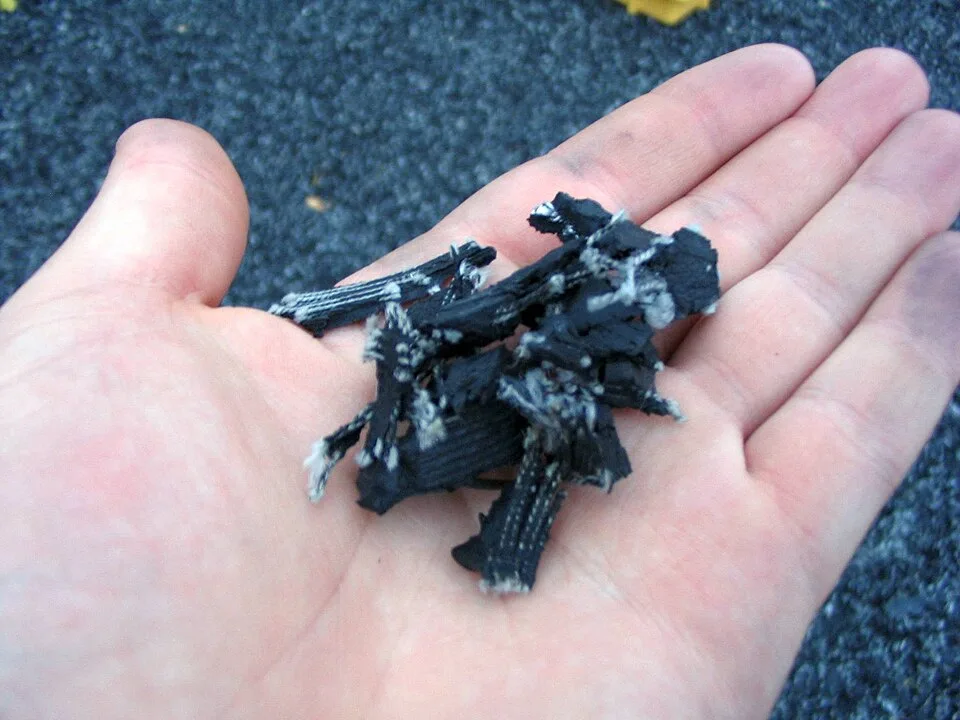
Millions of American homeowners spent more money than they needed to on rubber mulch because the bag said it was the responsible, eco-friendly choice. It was made from recycled tires, it would never rot, and it would save the planet one flower bed at a time. What the bag did not mention is that every rainstorm has been quietly washing a fish-killing chemical compound from those tidy garden beds into the nearest creek.
The Pitch Was Good. The Chemistry Is Horrible.
Rubber mulch is exactly what it sounds like: shredded scrap tires ground into colorful nuggets that look, at a glance, like wood chips. The sales logic is clean and genuinely appealing. American motorists burn through more than 300 million tires a year, according to ecoportal.net, and those tires do not exactly biodegrade gracefully in a landfill. Rubber mulch manufacturers positioned their product as a two-fer: keep tires out of dumps, keep weeds out of your garden. Permanent, pretty, and practically maintenance-free.
The problem is that car tires are not simply rubber. They are a dense chemical cocktail, and when it rains, that cocktail goes somewhere. Ecoportal.net identifies the leachate from rubber mulch as containing aluminum, cadmium, chromium, copper, iron, magnesium, manganese, molybdenum, selenium, sulfur, and zinc. Zinc alone can make up as much as 2 percent of a tire's total mass. Several plant species accumulate dangerously high levels of it. Some of them die. That is the garden problem. The water problem is considerably worse.
Scientists Watched Salmon Die for Decades Before They Found the Culprit
For years, researchers studying coho salmon in the Pacific Northwest watched adult fish swim into urban creeks to spawn and die within hours of arriving. Not some of them. Regularly, more than half. Sometimes all of them. The fish were completing a migration thousands of years in the making and then just dropping dead before they could reproduce, and for a long time nobody could say why.
The answer turned out to be a compound called 6PPD-quinone. As ecoportal.net reports, it forms when an antiozonant additive in tires reacts with ozone in the atmosphere. Tire particles carrying 6PPD-quinone wash off roads during rainstorms and into rivers and streams, where research published in Science found the compound present at concentrations high enough to account for acute toxicity events in coho salmon. Every tire on every American road produces it, continuously, season after season. And rubber mulch, sharing the same chemical ancestry as road tires, leaches the same compounds into garden soil and from there into the same urban watersheds.
The Bill Gets Paid by Taxpayers and Fish
Here is what the rubber mulch price tag never reflected: the downstream cost. Washington State has authorized significant public funding over many years to pay for stormwater retrofit projects specifically designed to intercept this runoff before it destroys salmon populations. That is public money, spent cleaning up a problem that starts with tire chemistry and gets compounded at the retail garden level by homeowners who thought they were doing something responsible.
The stakes are not abstract. Coho salmon anchor entire fishing economies, tribal treaty rights, and cascading downstream ecosystems in the Pacific Northwest. When a keystone species gets wiped out spawn after spawn by a chemical compound in a garden bed accessory, the damage does not stay in the creek. Ecoportal.net draws a comparison to bee colony collapse, which threatens billions of dollars in US crop pollination. Different chemical crisis, same basic lesson about what happens when we break the things we depend on without realizing we are breaking them.
The Fix Is Embarrassingly Simple
Research has shown that well-designed bioretention soil mixes can strip the vast majority of 6PPD-quinone out of stormwater runoff, and juvenile coho exposed to that treated water survived. Washington State transportation authorities are pursuing highway stormwater treatment projects on that basis. That is the large-scale infrastructure answer.
At the garden level, the solution requires zero public funding and approximately zero sacrifice. Shredded wood chips, leaf litter, and straw suppress weeds just as effectively as rubber mulch, cost the same or less, and actually decompose into nutrients that feed the soil. Rubber mulch contributes none of that. It just sits there looking tidy while it silently offgasses heavy metals and polycyclic aromatic hydrocarbons into the ground beneath it. Organic mulch does the job better, costs less, and does not participate in a salmon die-off. That is the whole trade-off.
The Dingo Take
There is a particular kind of infuriating in this story, and it is the infuriating of good intentions meeting bad chemistry. Nobody buying rubber mulch was trying to kill salmon. They were trying to do the right thing, recycle tires, skip the annual top-up, stop weeds from taking over the hydrangeas. The product was marketed as the responsible choice. It had the aesthetics of sustainability without any of the substance. This is what happens when an industry gets to write its own environmental credentials and nobody checks the label for the part about zinc concentrations and neurotoxic fish kills.
The harder version of this story is about how many products work exactly this way. The cost gets externalized so completely, pushed so far downstream literally and figuratively, that the person making the purchase never sees it. Homeowners in suburban Seattle spread rubber mulch in April. Coho salmon die in September. The connection never gets made because there is a lot of road and a lot of rain between those two events. That gap is where industry has always hidden its bills.
Wood chips. Leaf litter. Straw. The boring answer was correct the whole time, and it was cheaper. If there is a through-line in environmental news, it is roughly that: the simple, unglamorous, un-packaged option usually turns out to be the one that does not poison a watershed. The premium eco-branded product with the compelling origin story often turns out to be the one that needs a publicly funded stormwater retrofit program to clean up after it.




Comments