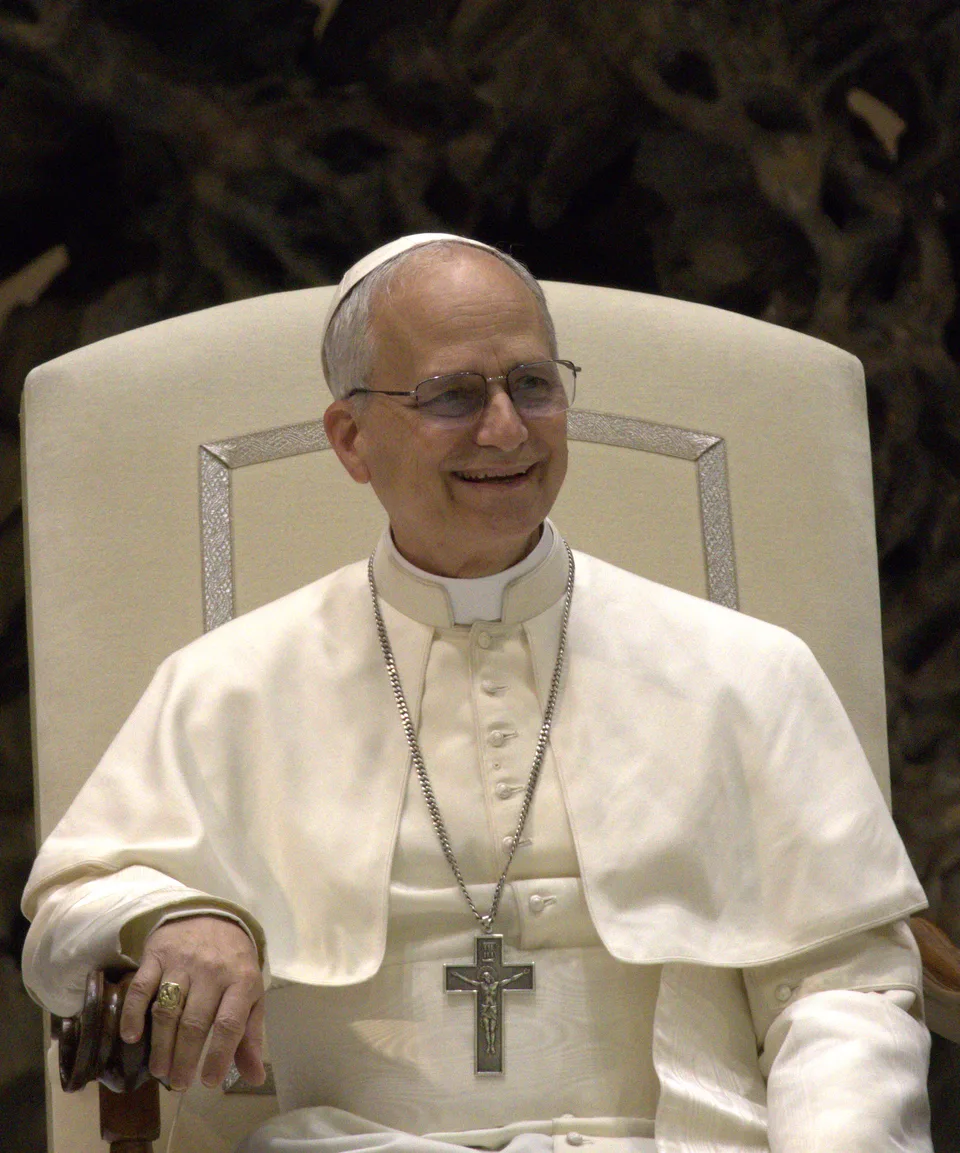
The sitting pope looked out at a global political order run by Donald Trump, Vladimir Putin, and Benjamin Netanyahu and called them, with essentially zero ambiguity, a 'handful of tyrants ravaging the world.' He then convened every cardinal in the Catholic Church and tightened the rules on when war is morally permissible. While American politicians were busy arguing about whether Watergate was actually a big deal, the guy in the white robe was doing actual moral philosophy.
The Three Men Currently Breaking the World
The Guardian's Simon Tisdall lays out a pretty unsparing diagnosis of the current moment: Trump, Putin, and Netanyahu share a specific constellation of traits. Violence as a policy preference. A chilling absence of compassion. Paranoia dressed up as strength. And a fundamental inability, or unwillingness, to operate within any moral framework that doesn't begin and end with their own immediate interests.
This isn't just a vibes assessment. Putin's Russia is firing missiles into Ukrainian civilian neighborhoods. The United Nations has accused Netanyahu's Israel of targeting children in Gaza as part of what the UN describes as a genocide. And the Trump administration, per Tisdall's reporting, oversaw the mass killing of primary school children in Minab during what he characterizes as an unlawful U.S.-Israel war on Iran, an atrocity that wasn't covered up so much as arrogantly ignored by the people responsible for it.
And then there's JD Vance, who told the American public last week that the Watergate scandal, the thing that ended Richard Nixon's presidency because he conspired to subvert the Constitution and lied to the country, would not be a big deal today. He said that out loud. In public. As if it were a reasonable observation and not a confession.
When the Pope Is the Most Coherent Voice in the Room
Into this specific political hellscape steps Pope Leo, leader of 1.4 billion Catholics, who has apparently decided that diplomatic hedging is for lesser men. Speaking in April, as The Guardian reports, he condemned 'a world ravaged by a handful of tyrants' while leaving, quote, 'little doubt in Washington, Moscow and Jerusalem who he meant.' That's not a vague denunciation. That's a list.
Leo has also gone directly after Vance and Defense Secretary Pete Hegseth, both of whom have invoked Christian justification for acts of military aggression. The pope's response was not subtle. 'Woe to those who manipulate religion and the very name of God for their own military, economic and political gain, dragging that which is sacred into darkness and filth.' If you've ever wanted to see a sitting pope tell two American officials to go to hell without technically saying it, this is the closest you're getting.
To be clear about what's happening here: the Catholic Church, an institution not historically known for its spotless moral record, is currently outperforming the United States government on basic ethical coherence. That's where we are.
What Leo Actually Did About It
This is the part that separates Leo from the parade of world leaders who give good speeches and then go home. He convened a consistory, which The Guardian describes as a rare gathering of all the Catholic Church's cardinals, in Rome last weekend. The goal was substantive: tighten the centuries-old just-war theory that has been consistently hijacked by governments looking for theological cover to start wars they wanted to start anyway.
Leo's new framework, drawn from Augustine and Aquinas, is straightforward. War is only morally justified for proportional self-defense, and only after every peaceful option has been exhausted. 'War is never worthy of humanity, and it is never blessed by God,' he told the assembled cardinals. He also argued that war doesn't just happen between states. It originates in what he called 'a culture of power,' and the world has to rebuild a culture of cooperation instead.
Apply that framework to, say, the decisions made in Washington and Jerusalem over the past few years and see how they hold up. Take your time.
Leo Isn't Alone, But He's the Loudest
The Guardian notes that this moral recalibration is broader than just the Vatican. Sarah Mullally, the newly enthroned Archbishop of Canterbury, met Palestinian Christians in the West Bank last month and urged what she called 'faithful resistance' to Israel's expanding occupation. In a pastoral letter, she wrote that the international community has a 'moral responsibility' to relieve suffering in Gaza and the West Bank, and that the conflicts there are 'symptomatic of a deeper political and spiritual crisis, an abandonment of international law and an increasing recurrence of military force.'
Islamic and Jewish religious thinkers have also engaged in what Tisdall frames as a broader struggle for the soul of the new world order. You don't have to be religious to find this at least mildly encouraging. You just have to be someone who noticed that the people running governments right now aren't filling the moral leadership gap, and someone has to.
When you're relying on religious institutions to carry the weight of basic ethical argument against mass civilian casualties and governmental corruption, something has gone seriously sideways. But here we are.
The Contagion of Moral Collapse
Tisdall's piece makes a point worth sitting with. He argues that the normalization of immoral conduct in public life may be Trump's most durable legacy. Not the tariffs, not the deportations, not even the specific policies. The shrug. The implication that corruption is just how things work now, that lying to the public is unremarkable, that killing civilians in another country is something you simply move past.
Vance's Watergate comments are the clearest expression of this. He wasn't making a legal argument. He was making a cultural one. The standard has changed. You can subvert the Constitution, behave criminally, and deceive the country, and the appropriate response is not outrage but a kind of exhausted acceptance. That's the message. And if enough people accept it, the message becomes true.
Tisdall also points out that international law, in theory, provides a separate moral framework that operates above individual leaders. In practice, its indictments get flouted, its constraints bypassed, and nobody with real power faces meaningful consequences. The ICC issued arrest warrants for Netanyahu. How's that going.
The Dingo Take
Here is the actual situation: a 69-year-old man in a white robe is doing more substantive moral work right now than the combined governments of the United States, Russia, and Israel. Pope Leo convened a historic gathering of cardinals, issued a direct condemnation of three sitting world leaders, called out two American officials by name for weaponizing Christianity, and laid out a coherent philosophical framework for when violence is and isn't justified. Meanwhile, JD Vance told a reporter that Watergate was probably not that big a deal. These things happened in the same week.
You do not have to be Catholic. You do not have to be Christian. You do not have to believe in anything other than the basic proposition that killing children in schools is bad and that people in power should be held to some standard of conduct. If you believe those things, the pope is currently your closest ally in a major world institution, and that should feel at least a little strange.
The Guardian's Tisdall ends with the observation that moral collapse is contagious but that pushback is possible, and that every citizen who fails to speak out shares some of the fault. That's uncomfortable. It's also correct. The 'handful of tyrants ravaging the world' that Leo identified are not operating in a vacuum. They are operating with the tolerance, the exhaustion, or the active support of enough people to keep them in power. The question of what moral leadership looks like right now has a clear answer. The harder question is who's actually listening.


Comments