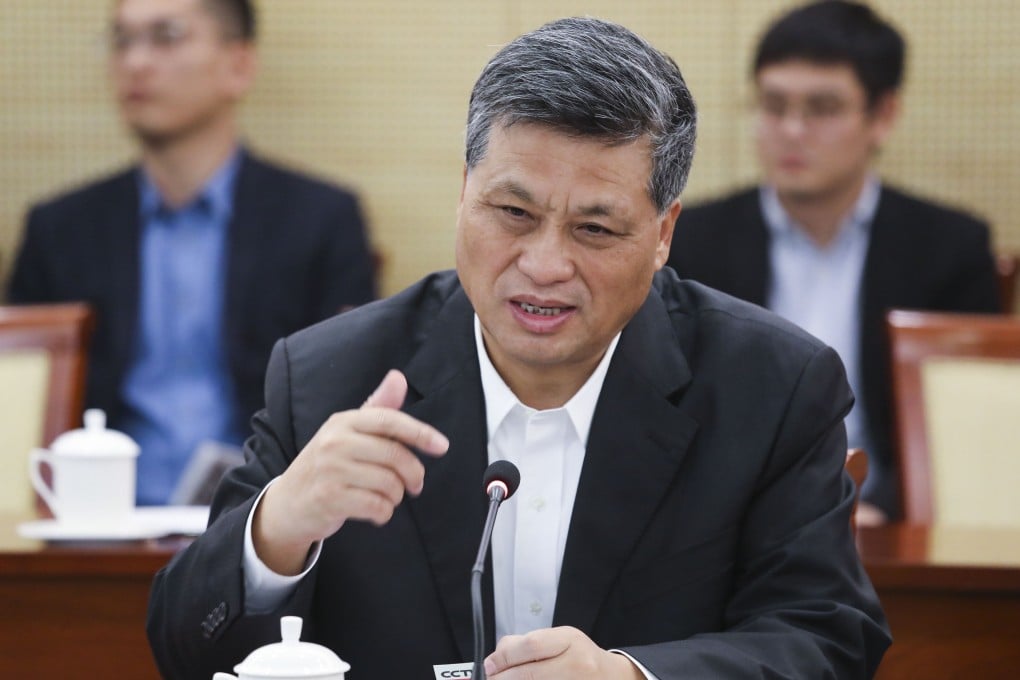
China just kicked its third Politburo member out of the party in a single term, something that hasn't happened in decades, after investigators concluded that former Xinjiang party chief Ma Xingrui engaged in 'rampant corruption' and dragged his family into it. Ma, 67, who once ran China's new-generation carrier rocket programme before climbing to the very top of the party's power structure, is now a cautionary tale about what happens when Xi Jinping's anti-corruption machine decides it's your turn. Whether this is justice, a purge, or some combination of both is, as always with China, a matter of considerable debate.
Who Is Ma Xingrui and Why Should You Care
Ma Xingrui isn't some minor bureaucrat caught with his hand in the till. This was a Politburo member, which puts him in the roughly two-dozen-person body that sits just below the all-powerful Politburo Standing Committee and effectively runs the world's most populous country. You don't get there by accident.
According to the South China Morning Post, Ma's career was impressive by any standard. He led China's new-generation carrier rocket programme, served as deputy party secretary of Guangdong, ran the boomtown of Shenzhen as party secretary, worked his way up to provincial governor, and then landed in Xinjiang as party chief, one of the most politically sensitive posts in the country given the region's ongoing human rights controversies and heavy security apparatus.
So when someone with that resume gets described by state media as having 'lost his ideals and beliefs' and 'betrayed the party's principles and original mission,' the fall is not a small one. This man had a rocket programme named after his career trajectory. Now he has an expulsion notice.
What the Party Says He Did
The Central Commission for Discipline Inspection, which is Xi's anti-corruption enforcement arm and is not an institution known for understatement, concluded that Ma 'seriously violated the party's political discipline and rules.' State-run Xinhua reported that the Politburo itself reviewed and approved the findings on June 30, with the formal announcement coming Tuesday.
The specific charge that corruption extended to his family is the detail worth sitting with. In Chinese anti-corruption cases, 'family involvement' typically means that relatives used their connection to a powerful official to extract bribes, contracts, or favors, often with the official's knowledge and sometimes with their active participation. The CCDI called it 'rampant.' That is not a word they typically reach for unless they want to make a point.
China announced the investigation into Ma back in April, the South China Morning Post reports, so the conclusion was not a surprise. But the formal expulsion from the party and dismissal from public office is the final, irreversible hammer coming down.
Third One This Term, Which Is a Big Deal
Here is the number that really matters: three. Three Politburo members investigated in a single five-year term, a situation the South China Morning Post describes as 'unseen in decades.' The current term began in 2022. That means Xi's inner circle has shed three members to corruption investigations in less than four years, which is either proof that the anti-corruption campaign is ruthlessly effective, or proof that the Politburo was absolutely riddled with people helping themselves, or both.
For context, the Politburo has around 24 members. Losing three in one term to corruption is like a corporate board losing three directors to fraud charges during the same administration. At some point you stop calling it a few bad apples and start asking questions about the whole orchard.
Previous Politburo members caught in the current wave included figures tied to the military. Ma's background is in civilian industrial and regional governance, which suggests the campaign is not narrowly focused on any one sector. Xi appears to be making the point that nowhere is safe.
The Xinjiang Dimension
It would be journalistic malpractice not to note where Ma was serving when all of this allegedly went down. Xinjiang is the region where China has been accused by the United Nations, the United States government, and human rights organizations of operating a mass detention and surveillance system targeting Uyghur Muslims. It is also a region where, precisely because of that security apparatus, oversight of how money and power actually flow is extraordinarily opaque to the outside world.
Ma was the top party official there. Whatever corruption occurred, it occurred in one of the most tightly controlled and least transparent corners of Chinese governance. The CCDI has given us the verdict. The receipts, as with most things involving Xinjiang, remain locked behind a wall that foreign journalists and investigators cannot get anywhere near.
The Dingo Take
Xi Jinping has staked a massive portion of his political brand on the idea that he is cleaning up a corrupt party and restoring its moral authority. The anti-corruption campaign is real, the prosecutions are real, and the fear it has generated among Chinese officials is also very real. But three Politburo members in one term is not a success story for the system. It is an indictment of it. These weren't outside criminals who snuck in. They were the people Xi's party elevated to its highest ranks.
The language the CCDI uses in these cases is always worth reading closely, because it is the party talking to itself in its own ideological vocabulary. 'Lost his ideals and beliefs.' 'Betrayed the party's principles and original mission.' What they are really saying is: this man stopped believing in the fiction and started acting accordingly, taking what he could while he could because he knew the whole thing was more about power than principle. That reading is not paranoid. It is the most obvious interpretation of behavior that is apparently endemic at the highest levels of Chinese governance.
Ma Xingrui ran a rocket programme and ended up in a corruption case involving his whole family. Xi Jinping gets to look like the guy who caught him. The party gets to perform integrity. And the structural conditions that produce official after official willing to loot the system remain exactly where they were. Somewhere in Beijing, the next Ma Xingrui is watching this very carefully and recalculating their risk tolerance.




Comments