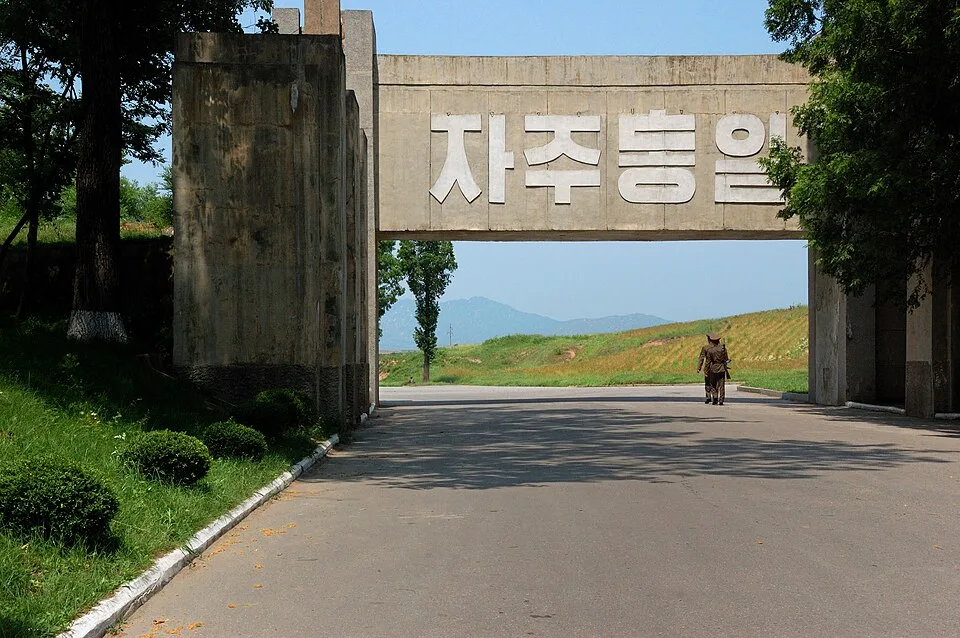
North Korea is building fences, digging trenches, and laying fresh minefields less than 100 meters from the line that's supposed to keep the Korean Peninsula from blowing itself apart. South Korea is alarmed. The UN Command is investigating. Kim Jong Un, meanwhile, has the full backing of Moscow and Beijing and appears to be having the time of his life.
What's Actually Happening at the DMZ
Let's be precise about this, because the details matter. The Demilitarized Zone is a 4-kilometer-wide buffer strip running 238 kilometers across the Korean Peninsula, created by the 1953 armistice that technically never ended the Korean War. It is one of the most heavily armed borders on earth. The military demarcation line runs exactly down its middle.
North Korean engineering troops have been busy. According to DW, they've erected new fences, constructed anti-tank berms and ditches, dug trenches, built military access roads, cleared land, and laid new minefields. All of it creeping steadily closer to that center marker. In some spots, the work is now less than 100 meters from the line.
South Korea's Defense Ministry spokesperson Chung Binna said at a June 25 press conference that military construction this close to the halfway point effectively kills the DMZ's purpose as a buffer zone. That's a polite way of saying North Korea is quietly dismantling one of the foundational mechanisms meant to prevent a second Korean War.
Flush With Russian Money and Running Out of Patience
Here's the context that makes this so much worse. North Korea didn't arrive at this moment broke and isolated. Pyongyang has spent the last two years sending troops and military equipment to support Russia's invasion of Ukraine, and that arrangement has been very, very good for Kim Jong Un. DW reports that North Korea is now emboldened by a deepening security and economic alliance with Moscow, plus a steady pipeline of advanced military equipment and dual-use technology from China.
Professor Dan Pinkston of Troy University's Seoul campus told DW that North Korea is essentially running the same playbook China used in the South China Sea, where Beijing absorbed reefs and atolls inch by inch with no coordinated international resistance to stop it. "This is a revisionist power that is dissatisfied with global governance and is looking to take advantage in any way it can," Pinkston said. The lesson Kim Jong Un appears to have drawn from watching China is that if you move slowly and stay just below the threshold of an obvious violation, the world will mostly shrug.
Choo Jae-woo, a foreign policy professor at Kyung Hee University in Seoul, put it even more bluntly to DW. "They are testing the limits. They know they have the support of both Russia and China in all their endeavors, and Pyongyang feels that now is the time to see how far it can go."
Kim Jong Un Redefined the Whole Relationship
This isn't coming out of nowhere. Experts told DW that North Korea stepped up its probing of DMZ boundaries around April 2024, a few months after Kim Jong Un made a declarative announcement that should have been bigger news than it was. He formally scrapped the longstanding goal of Korean reunification and redefined the relationship between North and South Korea as one between "two hostile countries and two belligerents at war."
That's not a throwaway line. That's a doctrinal shift. For decades, however dysfunctional and violent the relationship between the two Koreas got, there was at least nominal rhetorical space for the idea that they were one people with a shared future. Kim killed that framing officially and then started physically reinforcing the kill with shovels, fences, and landmines. The DMZ construction is the physical expression of a political decision that's already been made in Pyongyang.
So Is This Actually a Violation or Not?
This is where the UN Command comes in, and where things get genuinely complicated. In a statement to DW, the UN Command said it continues to monitor the situation but stopped well short of calling any of this a violation. Its June 23 fact sheet said that constructing roads and fences is technically permitted under the armistice, as long as the work stays north of the demarcation line. Laying mines is also allowed. South Korean forces do their own vegetation clearing.
However, the UN Command also confirmed it is still investigating reports that North Korean fences may have already crossed the MDL and that mines have been laid on the South Korean side of the line. "Emplacing mines south of the MDL ceases to be defensive and is an automatic violation," it said. "Any confirmed crossings will trigger immediate armistice violation protocols." The UN Command also stated there are currently no indications of North Korea bringing heavy weapons or drone capabilities into the DMZ, which would be a clear breach.
So the official answer is: possibly not a violation yet, but we're watching, and the margin is getting uncomfortably thin. Professor Pinkston confirmed to DW that North Korea's actions to date technically fall short of violating the 1953 armistice. The word "yet" is doing a lot of work in that sentence.
The West Sea Is Probably Next
Professor Choo told DW he would not be surprised if North Korea soon starts testing the Northern Limit Line, the disputed sea border off the peninsula's west coast. This is not a hypothetical threat with no historical weight behind it. In 2010, North Korea fired approximately 170 artillery rounds at the South Korean island of Yeonpyeong, killing four people and injuring 19. That was fifteen years ago and it remains one of the most serious military attacks on South Korean territory since the armistice.
North Korea is also building advanced new warships, which Choo flagged as part of the same pattern of assertive military development. The DMZ engineering work, the naval buildup, the formal hostile-nations framing, the Russian alliance. These are not separate stories. They are a single, deliberate strategy being executed by a government that has done the math and concluded the current international environment is too distracted to push back hard.
The Dingo Take
Let's be honest about what this situation is. North Korea is slowly redrawing the most dangerous military boundary in Asia, in real time, using shovels and minefields and the cover of technical armistice compliance, while the UN Command issues carefully worded statements about monitoring and assessment. And it's working. Because Kim Jong Un correctly identified that the world is busy: Russia has Europe in crisis mode, China is rattling sabers over Taiwan, and the United States is governed by an administration that can barely maintain a coherent foreign policy posture for 72 consecutive hours.
The South China Sea comparison that Professor Pinkston raised to DW should genuinely terrify people. China spent years doing exactly what North Korea is doing now: incremental, just-barely-legal moves that each individually looked manageable, until one day the map looked completely different and there was no obvious moment to point to where things went wrong. The frog didn't notice the water temperature. South Korea is currently the frog.
There's no clean ending here. Short of a military confrontation that nobody wants, South Korea and its allies are essentially watching the buffer zone get quietly hollowed out from the inside while the bureaucratic machinery of armistice compliance runs its slow, careful process. Kim Jong Un has cash, guns, powerful friends, and a plan. What does the other side have? Monitoring. Assessment. Established mechanisms. Sleep well.




Comments