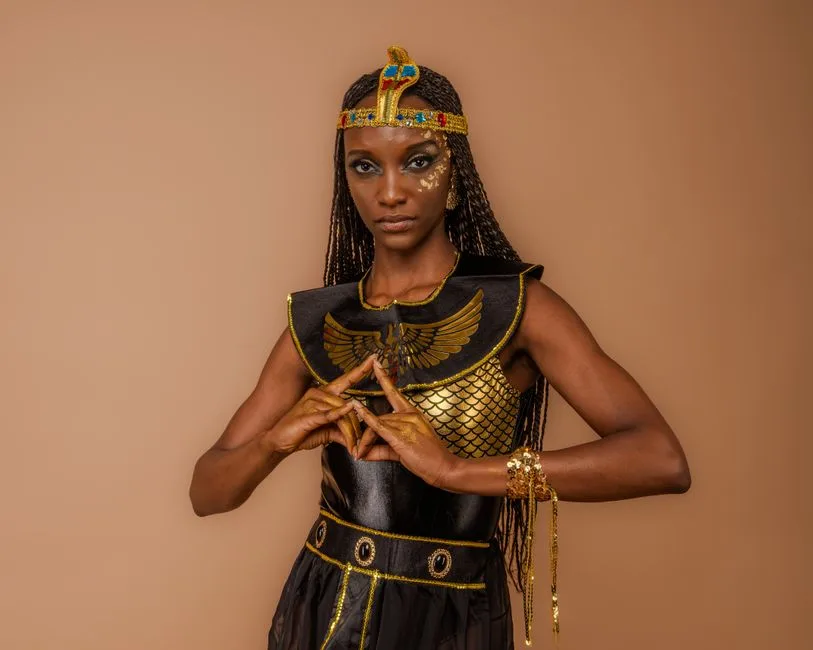
Someone was cleaning out the basement of the Egyptian Museum in Cairo and found a box of mummified royals that had been sitting there, forgotten, for over a hundred years. Inside: five ancient Egyptian princesses buried with daggers, maces, and bows and arrows. Archaeologists assumed the weapons were symbolic. The bones said otherwise.
The Most Important Basement Cleanout in History
According to NPR's Short Wave podcast, the Egyptian Museum in Cairo rediscovered these remains during what can only be described as a very productive spring cleaning. The box contained the mummified remains of six members of an ancient Egyptian royal family: five princesses and a king, all of whom lived around 1800 B.C. They had been excavated more than a century ago and then, apparently, filed away and forgotten about. Which, sure. That happens.
When archaeologists first looked at the remains, they noticed the women were buried with an arsenal. Daggers. Maces. Bows and arrows. The immediate assumption, as NPR reports, was that the weapons were symbolic. Ceremonial. Just sort of decorative grave goods that didn't really mean anything about who these women actually were in life. Because obviously, right? Princesses. Probably very delicate. Probably very concerned with their jewelry.
Enter the Bioarchaeologist Who Refused to Buy That
Zeinab Hashesh, a bioarchaeologist at Beni-Suef University in Egypt, was not buying it. As she told NPR, everyone carries this assumption that ancient princesses were like Disney characters: fluffy, decorative, in beautiful dresses. Hashesh looked at the actual bones instead of the assumption, and here is what she found: these women had seriously developed muscle attachments. Strong ones. The kind that take years of physical training to build.
In other words, these princesses were, as NPR's Hannah Chinn put it without a hint of irony, buff. The weapons weren't props. They appear to have been tools. These women trained. They were, in some meaningful physical sense, warriors. A finding that upends, as NPR frames it, some very long-held assumptions about how Egyptian royal women lived and what roles they actually occupied.
This is what happens when you actually look at the evidence instead of deciding in advance what you expect to find. Turns out the bones don't care about your preconceptions. They just sit there being correct.
Meanwhile, Your Guacamole Is Theoretically Doomed
In news that is genuinely alarming and not getting nearly enough attention, NPR also reported this week on the precarious genetic situation of the modern avocado. Specifically: over 80% of commercial avocado production worldwide comes from a single variety, the Hass avocado. Every single one of them is genetically identical. Every single one is therefore vulnerable to the exact same diseases in the exact same way.
Archaeobotanist Kevin Wann, a fellow at the Smithsonian Museum of Natural History and a PhD candidate at Texas A&M, published research this week in the journal Plants, People, Planet looking at wild and heritage avocado varieties from Mexico and Central America. He collected DNA from varieties found mostly in local farms and home gardens, sequenced their genomes, and compared them to an existing archive of avocado genetics. What he found was a striking amount of genetic diversity that has been quietly preserved for thousands of years by farmers who had no idea they were doing future generations a favor.
Wann also found varieties of Nicaraguan avocados that were genetically close to South American ones, suggesting ancient farmers transported and then hybridized them with native species across the region. Anthropologist Amber VanDerwarker of UC Santa Barbara, who was not part of the study, told NPR the research reveals how much genetic wealth these ancient farming communities preserved, and how important it is to keep that diversity alive if avocados are going to remain a viable crop going forward. So: your guacamole is fine right now. It is not guaranteed to be fine forever. Someone is working on it.
The Birdsong Thing Is Also Cool, Look
NPR rounded out its science roundup with a global study on birdsong, which NPR's Nate Rott described as "trilling," a pun he was clearly very pleased with. The details on this study were lighter in the broadcast, but the broader point was about understanding the building blocks of how birds learn and produce song across different species worldwide.
We mention it here mainly because the juxtaposition of warrior princesses, agricultural biodiversity, and bird vocal cords all landing in the same week of science news is either proof that the world is endlessly interesting or proof that science reporters are working extremely hard while the rest of us argue about things on the internet. Probably both.
The Dingo Take
The Egyptian princess story deserves to sit with you for a minute. These women have been dead for roughly 3,800 years. Their remains were dug up, boxed, and forgotten in a museum basement for over a century. And even when archaeologists rediscovered them and found them buried with literal weapons, the working assumption was still: nah, decorative. Because that is how deeply we project gender expectations onto history. We look at evidence and then explain it away with whatever story we already believe.
It took a bioarchaeologist who decided to read the bones instead of the narrative to establish what the bones were clearly saying the entire time. These women were physically trained. They were strong. They were buried as warriors because, in some genuine sense, that is what they were. That should not be a surprising finding in 2026. The fact that it still registers as a discovery says a lot about whose stories we have chosen, over and over again, to tell as the default version of the past.
As for the avocado situation: put it on the list of things that are technically fine right now but quietly accelerating toward a problem we absolutely could have addressed earlier and mostly chose not to. The Hass monoculture is a known vulnerability. The genetic diversity exists to fix it. The ancient farmers who preserved that diversity for thousands of years did their part. Whether we do ours is, as always, a question about priorities. Right now, we are choosing the cheap consistent guacamole. We are extremely good at choosing the cheap consistent guacamole.


Comments