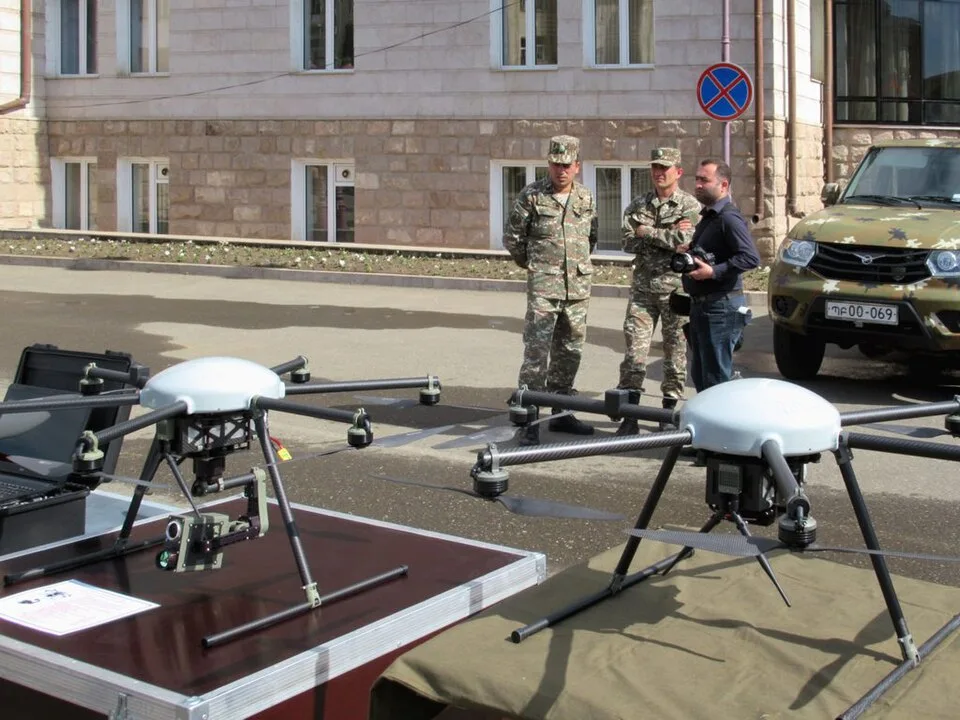
Oil hit $100 a barrel this week, and if you've been blaming inflation or OPEC or whatever villain is trending, here's the more honest answer: drones. Cheap, proliferating, increasingly precise drones are tearing through refineries and oil tankers in Iran and Ukraine, and the disruption is rippling straight into your gas tank and your wallet. This is not a future problem. It is the problem, right now, today.
The $100 Question Nobody's Answering Honestly
According to Axios, oil traded at $100 per barrel this week. That's a number that makes economists sweat and politicians go quiet, because explaining it requires admitting something uncomfortable: the global energy system was built for a world where blowing up a refinery was hard, expensive, and usually required a nation-state with an air force and a death wish.
That world is gone. The drone tech revolution has made striking energy infrastructure cheaper and easier than at any point in history. A refinery that took decades to build and billions to finance can now be disrupted by hardware that fits in a pickup truck. The arithmetic of destruction has permanently shifted, and the price at the pump is where regular people feel it first.
Two Wars, One Very Expensive Lesson
The wars in Iran and Ukraine are functioning as a live demonstration of what happens when drone warfare meets critical energy infrastructure. Axios reports that both conflicts are showcasing how the technology makes it dramatically simpler to interrupt energy supplies by going after refineries and oil tankers directly. These aren't incidental side effects of fighting. Hitting energy is the strategy.
This matters beyond the immediate casualties and immediate price spikes. Every pipeline engineer, every LNG port planner, every grid operator on earth is watching these conflicts and updating their threat models in real time. The lesson being taught is brutal and clear: if you build it, someone can now drone it, and the someone doesn't need to be a superpower to pull it off.
Energy Infrastructure Built for the Wrong Century
Here's the uncomfortable structural reality. The global energy system, pipelines, refineries, liquefied natural gas ports, power grids, was designed and built under a set of assumptions about what threats looked like. Large military operations. State actors. Things you could see coming and potentially deter. The drone revolution has invalidated most of those assumptions without anyone officially announcing it.
Axios notes that policymakers and companies are now being forced to rethink how they view all of that infrastructure in light of how drones are reshaping modern warfare. That rethinking is happening fast, because the conflicts in Iran and Ukraine are not theoretical case studies. They are ongoing, they are escalating, and they are providing a constantly updated playbook for anyone who wants to cause maximum economic disruption with minimum resources.
The Stakes for Everyone Not Currently in a War Zone
You might reasonably ask why an oil tanker getting hit in a conflict thousands of miles away should determine what you pay at a gas station in Ohio or Oregon. The answer is that oil markets are globally integrated and pathologically anxious. Traders price in risk before the damage is even fully assessed. A strike on a major refinery doesn't just reduce supply today. It signals that supply anywhere is more vulnerable than previously understood, and that signal moves prices globally and immediately.
Looking ahead, as Axios frames it, the stakes here extend well into the future. Anyone planning new energy infrastructure now has to factor in a threat environment that didn't exist at this scale five years ago. That raises the cost of building anything, potentially slows investment in new capacity, and creates a long-term tightening dynamic that goes well beyond whatever happens in any individual conflict.
The Technology Gap Nobody Wants to Talk About
There's a crueler irony embedded in this story. The same technological progress that's given us cheap consumer drones for photography and package delivery has also handed anyone with a grievance, a sponsor, or a military budget a precision strike capability that previously required jet fighters and trained pilots. The barrier to entry for disrupting global energy markets has never been lower.
Defense and energy planners have known this was coming. The warnings were there. But knowing something is coming and actually retrofitting a century of global energy infrastructure to defend against it are entirely different propositions. The gap between awareness and action is where $100 oil lives.
The Dingo Take
Let's be clear about what's actually happening here. The price of energy is being set, in meaningful part, by the intersection of cheap drone technology and the catastrophic decision by multiple parties to wage or provoke wars near critical energy chokepoints. This is not a market failure in the classical sense. It's a security failure being expressed as an economic one, and the people absorbing the cost are the same ones who had the least say in any of the decisions that got us here.
The political response to expensive gas is always the same: blame whoever's in power, demand they 'do something,' and move on when prices tick down without ever reckoning with the structural causes. The drone revolution in warfare is a structural cause. It's not going away. If anything, the technology keeps getting cheaper and more capable, which means the vulnerability of centralized energy infrastructure is going to keep growing until someone actually commits to redesigning it or ending the conflicts that are proving out the playbook.
None of that is fast. None of it is cheap. And none of the people making the decisions about it are paying $5 a gallon out of pocket in any way that makes them feel the urgency. So buckle up, because $100 oil might start looking like the good old days if the next drone strike lands on something a little more critical than the last one.





Comments