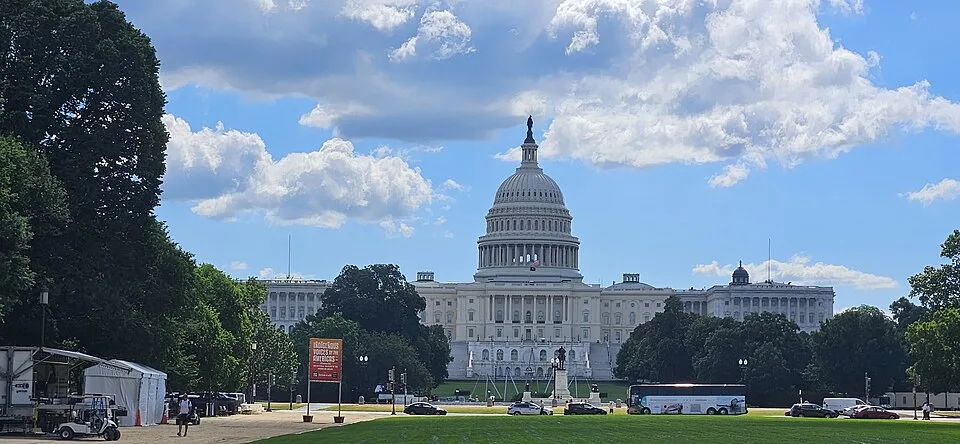
House Republicans spent their final week before a five-week summer vacation passing $95 billion in Iran war spending, a $1.15 trillion military budget, and a sweeping voter ID bill — and then watched four of their own members join Democrats to pass a resolution telling Trump to knock it off with the war. That's the story they're taking home to their constituents. Good luck out there, guys.
The Budget Chief Who Couldn't Say 'War'
Here's a detail that tells you everything you need to know about where House Republicans are politically right now. When Jodey Arrington, the chief Republican budget writer, took to the House floor to sell his colleagues on $95 billion in Iran war spending, he refused to say the word 'war.' Or 'conflict.' Or even 'Iran.'
According to The Guardian, Arrington called it 'just baseline battlefield readiness' — bullets and bombs, he said, 'to finish the job and come home safely and victoriously.' That's a genuinely impressive act of rhetorical cowardice from a man whose entire job is to put numbers on things. If you can't name the thing you're spending $95 billion on, maybe the spending is the problem.
The reason for the verbal gymnastics isn't hard to figure out. The Guardian reports that approval ratings for both the Iran war and Trump's presidency in general are in rough shape, and sticky inflation is making voters miserable. Going home and telling your district you just greenlit nearly a hundred billion dollars for a conflict you won't even name is not a great campaign pitch.
Johnson's Big Week Fell Apart Before the Weekend
Speaker Mike Johnson declared victory on Wednesday. 'Many of you like to say that major legislating can't happen in an election year,' Johnson told reporters, per The Guardian. 'We just proved you wrong.'
Less than 24 hours later, four Republican members broke ranks and joined Democrats to pass a war powers resolution that would require Trump to withdraw troops from combat against Iran. It was a symbolic vote, but symbolism is doing a lot of work in Washington right now, and the symbol here was: your own people don't trust you on this war.
That's the trajectory of Johnson's 'great week.' Wednesday: triumphant press conference. Thursday: embarrassing floor defeat. Friday: five weeks of recess to let it all marinate.
The Senate Didn't Even Pretend to Care
The Iran war spending bill passed through the House along party lines using the reconciliation procedure, the same budget trick Republicans have used twice before to dodge a Democratic filibuster in the Senate. The theory is that reconciliation lets you pass major spending with a simple majority. The practice, apparently, is that it doesn't matter if your own Senate majority leader won't touch it.
The Guardian reports that Senate Majority Leader John Thune said he'd put the Iran spending bill on 'hold' before the House even voted on it, keeping it as potential leverage in the coming fight over government funding, which runs out September 30. So the House went through the whole exercise of passing this bill on party lines, and the Senate's response was essentially: thanks, we'll keep this in a drawer.
The annual Pentagon budget, the National Defense Authorization Act, is running into its own wall. Johnson merged it with the Save America Act, a Trump-favored bill that would ban mail-in ballots and impose new voter ID requirements. That's a choice. Democrats have objected to the combined bill's $1.15 trillion price tag, and earlier this month they blocked the Senate version entirely in protest of the Iran conflict. The odds of any of this becoming law before the midterms look genuinely poor.
Democrats Smell Blood, and They're Not Wrong
Colorado congressman Jason Crow put it plainly after the war powers vote. 'You're about to have hundreds of members of Congress go home to their constituents, and a lot of folks are about to get crushed, rightfully so,' he told reporters, as The Guardian recounts. 'They're going to hear that people are losing healthcare, they're losing their homes, they're losing their farms, they're losing their small businesses. And why the hell are you supporting $100bn for another endless war in Iran?'
That's the Democratic pitch heading into November, and it's a coherent one. Healthcare cuts, farm losses, small business collapses, a war most people don't support, and a $95 billion price tag with no end date. Republicans handed Democrats a pretty clean villain narrative and then voted for it on party lines.
Democrats aren't without their own problems. The Guardian notes that the party's own supporters remain demoralized following Kamala Harris's 2024 defeat, and a Washington Post-Ipsos poll out this week showed the mood among Democratic voters isn't exactly celebratory. But 'demoralized base' is a very different problem than 'we just voted to fund a war our constituents hate while calling it baseline battlefield readiness.'
The Republican Campaign Chair Is Feeling Great, Actually
Richard Hudson, who chairs the National Republican Congressional Committee, is choosing optimism. 'Joe Biden and the Democrats are the ones that ran this country into the ditch, and we're on a rescue mission to save it,' he told The Guardian. 'We got a great story to tell to the voters.'
Hudson also pointed to Republican gains in redistricting. For Democrats to win back the House, he argued, they'd have to flip a lot of seats in Trump-friendly territory. That's a real structural advantage for Republicans, and it's not nothing. Gerrymandering is a genuine force multiplier regardless of how the country actually feels.
But structural advantages have limits, and the member most acutely aware of those limits was Nebraska's Don Bacon, one of the only Republicans representing a district Kamala Harris won. Bacon, who isn't running again, offered a quiet rebuke: 'The go-it-alone approach fails us in the end.' He said Trump should work more with Democrats. Nobody in leadership appeared to be listening.
The Dingo Take
Let's be clear about what happened here. House Republicans spent the last week before their summer vacation passing a war spending bill they couldn't name, a defense budget stapled to a voting restrictions law that has no shot in the Senate, and then watched their own members publicly undercut the speaker on the war. And their response is to go home for five weeks and tell constituents they have 'a great story to tell.'
The story is this: inflation is sticky, the war is unpopular, Trump's approval ratings are bad, and the Republican legislative strategy is to pass things on party lines that immediately stall in the Senate and never become law. Meanwhile, real people are losing healthcare and farms and businesses, and the House just found $95 billion for a conflict whose chief budget writer won't say its name out loud.
Three months until the midterms. The Democrats are demoralized and still haven't fully figured out what they stand for after 2024. Republicans have a redistricting cushion. None of that changes the fact that a lot of Republican members are about to spend five weeks in their districts explaining why they funded a war they can't call a war. Some of those conversations are going to be very uncomfortable. Good.



Comments