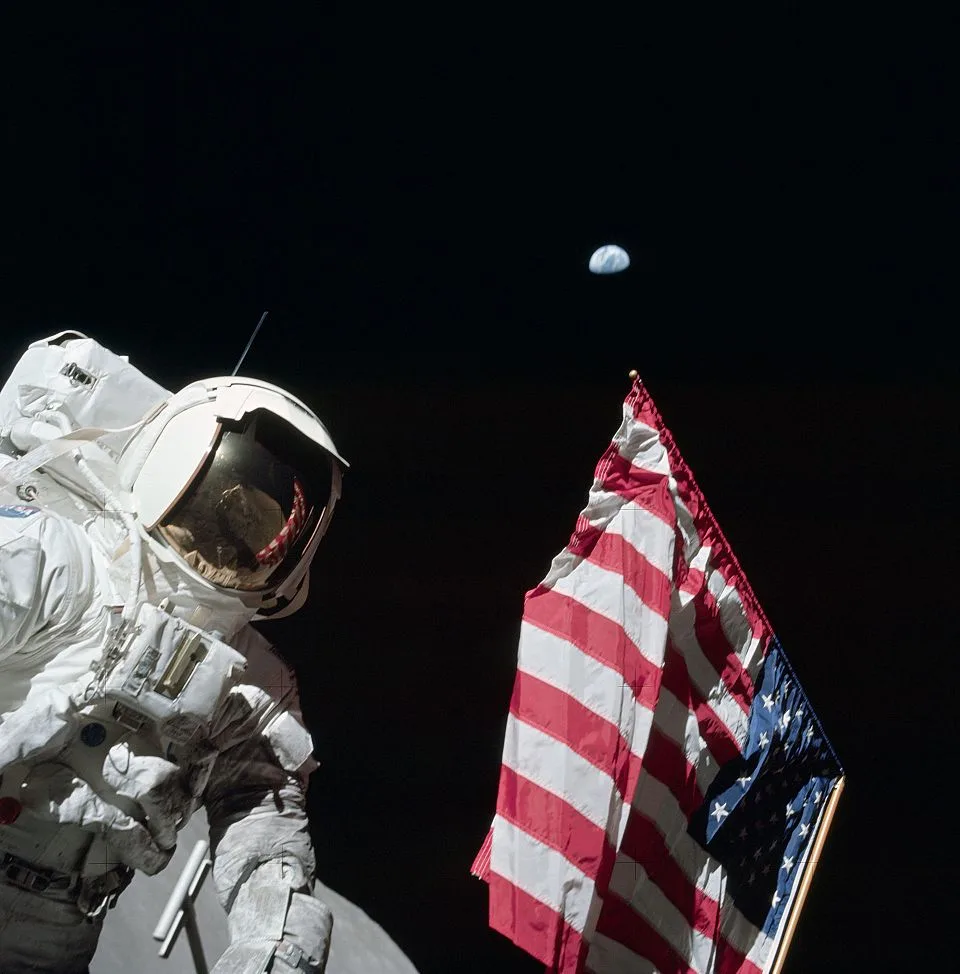
When the people who have literally looked down at Earth from 250 miles up and seen a single, unified country decide to form a political action group because they're scared for democracy, maybe the rest of us should put down our phones for a second. More than 100 retired NASA astronauts, people who have collectively logged thousands of days in space and walked on the moon and survived things that would make your stomach turn inside out, announced a new campaign called Astronauts for America this week. Their message: the country is broken, the constitution is being ignored, and young voters need to show up in November before it's too late.
The View From Up There Was Nicer
Astronaut Cady Coleman spent 180 days in space across multiple missions, including a lengthy stint on the International Space Station. From up there, she told The Guardian, she never saw red states or blue states. No ICE agents in camouflage. No sanctuary cities. Just America, coast to coast, looking like it still had its act together.
That perspective, shared by only a few hundred humans in all of recorded history, is exactly why Coleman and 107 of her retired NASA colleagues felt compelled to do something. They launched Astronauts for America on July 20, the 57th anniversary of the Apollo 11 moon landing, at the California Science Center. The timing was deliberate. Everything these people do is deliberate. That's what happens when your career involves not dying in the vacuum of space.
The group's Vote for Freedom campaign plans to hit roughly 60 college and university campuses this summer and fall, with a heavy focus on swing states and first-time voters. They want to grade midterm congressional candidates on their commitment to constitutional principles. They are, in other words, bringing the same checklist energy to saving democracy that they once brought to not exploding on re-entry.
"We May Not Make It" Is Not the Vibe You Want From a Former NASA Administrator
Charles Bolden is not a man given to hysteria. He is a retired Marine Corps major general, a four-shuttle-mission veteran, and the man who ran NASA through both of Barack Obama's terms. He has, by any reasonable measure, done some serious things in his life. So when Bolden says "we may not make it if we don't do something now," that lands differently than when your uncle says it at Thanksgiving.
According to The Guardian, Bolden was candid about the slow erosion of constitutional norms over several administrations, including Obama's reliance on executive orders, which he criticized even while understanding why it happened. But he was clear that the Trump administration's more recent assaults on democratic norms represent something qualitatively worse. "We may not have another presidential term to try to make a difference," he said.
That's a former NASA administrator and Marine general telling you this is a five-alarm situation. Not a partisan talking head. Not a Twitter account. A man who flew into space four times and ran the country's space program for eight years.
A Course Correction, Before the Ship Is Too Far Gone
The astronauts are leaning into space metaphors, and honestly, the metaphors are good. Coleman quoted her colleague Ron Garan: a small adjustment now means a large distance later. Get the course correction wrong, or wait too long to make it, and you miss the moon entirely. You don't get a second shot just because you meant well.
Linda Godwin, a scientist who logged 38 days in space across four shuttle missions and two spacewalks between 1991 and 2001, sits on the group's steering committee. She told The Guardian that astronauts aren't claiming to be smarter than everyone else. What they have is a specific kind of credibility: careers built entirely on truth, accountability, evidence, and trust, where cutting corners or ignoring inconvenient data could kill people. "We think our country is the mission," she said. Hard to argue with that framing.
The oldest member of the group is Rusty Schweickart, 90 years old, who flew on Apollo 9 in March 1969, four months before Neil Armstrong stepped onto the moon. The man watched America do the impossible once. He is now watching it struggle with things that, from his vantage point, must seem considerably more manageable.
Nonpartisan, But Not Naive
Astronauts for America is calling itself nonpartisan, and based on what Coleman told The Guardian, that framing seems genuine. She said the 108 members hold different political views, that she never asked colleagues about their politics during missions, and that the group includes people with varying opinions about current and past administrations.
Bolden's criticism of Obama's executive order habit backs that up. This isn't a group of Democrats in flight suits. It's a group of people whose professional lives demanded that they check their tribalism at the airlock, because tribalism at 250 miles up gets people killed. The constitutional principles they're defending, free elections, separation of powers, rule of law, aren't actually partisan principles. They're the floor. The current situation has made defending the floor feel like a radical act.
The group met on the 57th anniversary of the Apollo moon landing, surrounded by the living history of what America once agreed to attempt together. Whatever you think about the politics, the symbolism is not subtle. These are people who participated in one of humanity's great collective achievements, and they are now standing in front of young voters saying: please, we are begging you, go vote.
The Dingo Take
Here is the thing about Astronauts for America that should cut through even the deepest political fatigue: nobody joins this group for personal gain. These people already have the most impressive resumes on Earth, literally. They're not running for office. They're not selling books. They are retired scientists, pilots, and engineers in their sixties, seventies, eighties, and in Rusty Schweickart's case, nineties, who looked at the current state of American democracy and decided that staying quiet was no longer an option. That calculation should mean something.
The plan to grade midterm candidates on constitutional principles is smart and, if executed with the same rigor these people brought to actual spaceflight, potentially powerful. Voters in swing states who don't trust media or politicians might just listen to the people who flew the shuttle. It's not a guaranteed fix. Nothing is. But it's a real effort with real credibility behind it, and that's rarer than it should be.
Charles Bolden said the country may not make it. Cady Coleman said every voter can change the course of the nation. Both things can be true at once. The astronauts have done their course correction calculations. Whether the rest of the country pays attention is, as it always has been, entirely up to us.





Comments