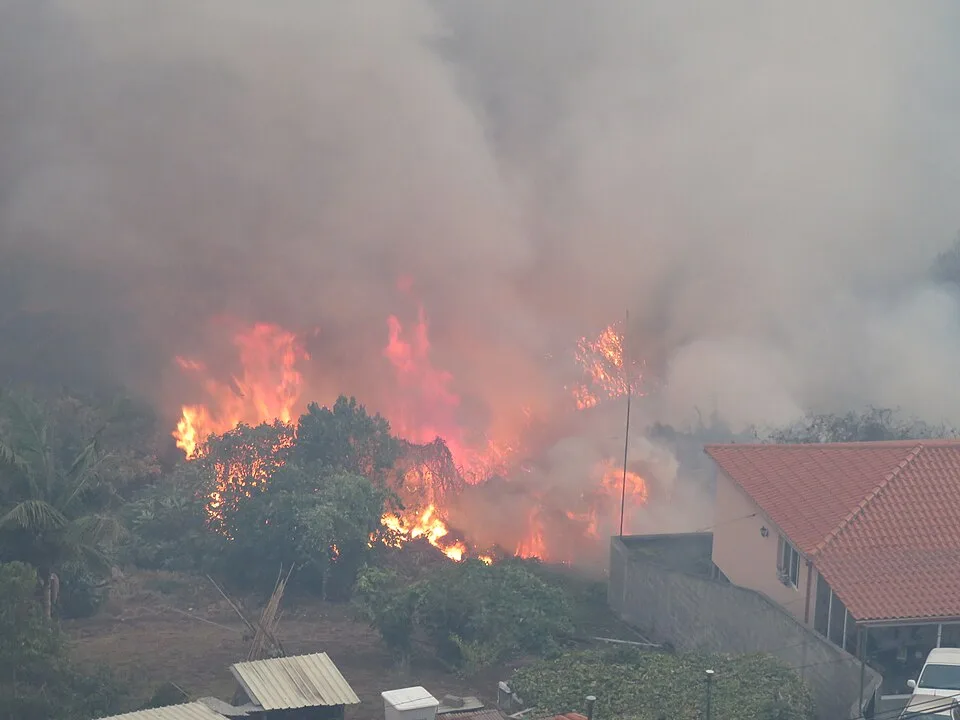
France just experienced its first pyrocumulonimbus, a fire-generated thunderstorm that makes wildfires nearly impossible to predict or contain, and which until now was considered a North American and Australian problem. Europe is on its third major heatwave of the summer with a fourth already incoming, 220,000 people have been evacuated in France alone, and temperatures in the southwest are expected to hit 40C by Wednesday. And the continent's political response has been to quietly loosen emissions rules and slash green funding.
When the Fire Starts Making Its Own Weather
Let's just sit with that for a second. A pyrocumulonimbus. A thunderstorm created by a wildfire, which then whips up winds in unpredictable directions, which then makes the fire harder to fight, which then potentially creates more of the same. France has never seen one before. It's seeing one now, in the Bordeaux region, in late July 2026, during its third major heatwave of the year.
According to The Guardian, French firefighters are grappling with terminology that until recently didn't apply to their country. This isn't a freak one-off event. It is what happens when you run a decade's worth of accelerating planetary heating and then act surprised that the consequences aren't staying neatly inside the borders of Australia and California anymore.
The numbers behind these fires are staggering. The Guardian reports that France has already burned a far greater area this year than the 30,000 hectares it lost during all of 2025. Spain's environment ministry calculates that more than 170,000 hectares have been scorched, compared with 29,000 hectares last year. Over 100,000 people have been forced to leave their homes in Spain. This is not a trend line. This is a collapse.
The Politicians Who Chose This Moment to Hit the Brakes
Here is where it gets truly breathtaking. In June, as The Guardian reports, Emmanuel Macron's government announced steep cuts to France's Green Fund, a program designed specifically to help local authorities respond to climate and environmental challenges. Timing-wise, this is roughly equivalent to canceling your fire insurance because the premiums seemed high and then watching your house burn down.
It gets worse at the EU level. This month, under pressure from Giorgia Meloni's Italy among others, the European Commission put forward proposals to weaken the EU's emissions trading system, which is Europe's central climate policy mechanism. The Guardian reports that under the proposed changes, heavy industry would receive free polluting permits for longer, and at lower cost. Free permits. To pollute. While the continent is on fire.
The justification offered for all of this is that Europe needs to be competitive. That green ambition is a luxury for stable times. That pragmatism demands a lighter touch on climate regulation. This argument was wrong before the summer started. It takes a special kind of intellectual commitment to keep making it while evacuation orders are going out to hundreds of thousands of people.
Spain's Prime Minister Said the Quiet Part Out Loud
Credit where it's due. Spanish Prime Minister Pedro Sanchez directly attributed the wildfire crisis to the climate emergency, which The Guardian notes is stating the obvious, but is somehow still a politically notable thing to do in 2026. He has also been pushing for the EU's green transition to be accelerated rather than rolled back.
He is, according to The Guardian, among the few leaders doing this. That sentence should make you want to throw something. The crisis is visible from space. The science has been screaming about this for decades. And the guy calling for faster climate action is notable because he's the exception.
Most of his counterparts have apparently decided that the correct response to accelerating climate collapse is to treat climate policy as an optional line item, something you fund when the economy is good and quietly defund when things get tight. The economy is, one might point out, going to get quite a bit tighter when your agricultural land is ash.
The 1.5C Number That Should Be Keeping Everyone Awake
The Guardian cites a recent study finding that if the warming rate of the last decade continues, the 1.5 degrees Celsius limit set by the Paris Agreement will be effectively obsolete by 2030. That is four years from now. Not four decades. Four years.
The Paris limit was always the bare minimum ambition, the floor below which the science said things get genuinely catastrophic. And Europe's governments are currently arguing about whether meeting it is too expensive and inconvenient, while a fire in France generates its own weather systems and a quarter million people sleep somewhere that isn't their home.
A fourth heatwave is already bearing down on Europe as this story develops. Temperatures in southwest France are forecast to hit 40C on Wednesday. The continent's firefighting infrastructure is exhausted. Its political infrastructure is retreating. And the gap between those two facts is where the real disaster lives.
The Dingo Take
The thing about a pyrocumulonimbus is that it perfectly captures what happens when you let a bad situation go long enough that it starts compounding itself in ways you didn't even know were possible. You get a fire so large and hot that it changes the atmosphere above it, creates its own storm, makes itself worse in new and creative ways. That is also a decent metaphor for the political response to climate change across Europe right now. The crisis has been compounding for years. The response has been to argue about whether doing something about it is too disruptive to business.
Macron cuts green funding as France enters its third heatwave. The EU weakens its emissions trading system as Spain burns through six times the acreage it lost last year. These are not random acts of negligence. They are choices, made by people with the information in front of them, who decided that the political cost of action was higher than the cost of the fires. Hundreds of thousands of evacuees might have thoughts on that calculation.
The Guardian's editorial board called this a dereliction of duty. That's the polite way to put it. The less polite way is that Europe's leaders are watching the continent become seasonally uninhabitable in certain regions and responding by making it structurally easier to keep burning fossil fuels. History is going to have a field day with this era, assuming anyone is around in a comfortable enough climate to write it.



Comments