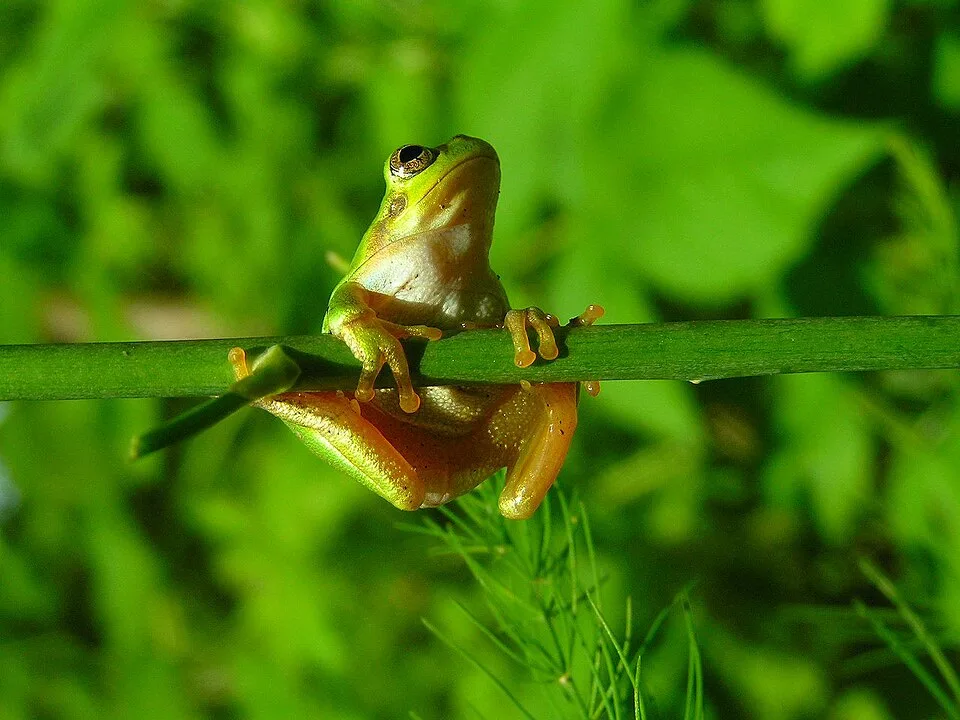
Researchers at the Japan Advanced Institute of Science and Technology have found a bacterium living inside the intestines of Japanese tree frogs that, in a single intravenous dose, completely eliminated colorectal tumors in every mouse they tested. One hundred percent. Gone. The findings were published in the journal Gut Microbes, and they are the kind of thing you have to read twice to believe you read correctly.
They went looking in frog guts and found this
The research team collected 45 bacterial strains from the intestines of three amphibian and reptile species: Japanese tree frogs, Japanese fire belly newts, and Japanese grass lizards. They screened each strain for anticancer activity, and nine of them showed some promise. One stood out completely.
The bacterium is called Ewingella americana, and according to ScienceDaily's coverage of the JAIST findings, it didn't just outperform standard cancer treatments in mouse trials. It made them look embarrassing. Compared directly against an immune checkpoint inhibitor and liposomal doxorubicin, a chemotherapy drug, E. americana produced better results. A single dose. Complete tumor elimination. The kind of result that makes oncologists sit up very straight in their chairs.
The researchers are careful to say this is mice, not humans, and that the road from promising mouse data to actual clinical therapy is long and littered with failures. That caveat matters. But "100% complete response rate" is not a phrase that shows up in medical literature very often, so it is worth understanding exactly how this thing works.
The bacteria basically trick tumors into letting them in
Here is where it gets genuinely fascinating. E. americana doesn't just kill cancer cells directly. It exploits the specific biology of tumors in a way that looks almost designed for the job, even though it obviously wasn't.
Tumors are oxygen-starved environments. Normal tissues aren't. E. americana is what's called a facultative anaerobic bacterium, meaning it can function in both oxygen-rich and oxygen-depleted conditions, but it thrives in the low-oxygen zones that exist inside tumor tissue. According to the JAIST researchers, once injected intravenously, the bacterial population inside tumors increased roughly 3,000-fold within 24 hours. The tumors essentially became the bacteria's preferred real estate.
Tumor blood vessels are also notoriously leaky compared to healthy vasculature, which means bacteria circulating in the bloodstream can slip into tumor tissue far more easily than into normal organs. On top of that, cancer cells produce high levels of a protein called CD47, which suppresses local immune activity. That suppression, designed by the cancer to protect itself from the immune system, inadvertently creates conditions where the bacteria can survive and multiply. The tumor's own defense mechanism becomes the door it leaves unlocked.
A double-barreled attack that woke up the immune system
The bacteria weren't working alone. The JAIST team found that E. americana's presence inside tumors triggered a significant immune response, attracting T cells, B cells, and neutrophils into the tumor environment. Those immune cells then released inflammatory signaling molecules, including TNF-alpha and IFN-gamma, which amplified the attack on cancer cells.
So the mechanism is two-pronged. The bacteria multiply inside the tumor and directly damage cancer cells. Then the immune system, alerted by the bacterial presence, shows up in force and finishes the job. It's the oncological equivalent of picking a lock and then calling everyone you know to help you ransack the place.
What makes this particularly interesting is the specificity. According to the researchers, E. americana accumulated almost exclusively inside tumors and did not colonize healthy organs. The liver, spleen, lungs, kidneys, and heart showed no bacterial colonization. The bacteria were cleared from the bloodstream within 24 hours, with a half-life of approximately 1.2 hours. Mild, temporary inflammation resolved within 72 hours. Over a 60-day observation period, the team found no evidence of chronic toxicity in the mice.
What comes next, and why you shouldn't book a celebration yet
The JAIST team is planning to test whether this approach works against other solid tumors, including breast cancer, pancreatic cancer, and melanoma. They also want to explore dose fractionation, direct tumor injection, and combinations with existing chemotherapy and immunotherapy. There is a lot of road ahead.
The history of cancer research is full of treatments that demolished tumors in mice and then fizzled, failed, or caused serious harm when applied to humans. Mouse immune systems are not human immune systems. The variables multiply dramatically when you move into human trials. No one at JAIST is claiming a cure for cancer. What they are claiming is proof of concept, and the proof is striking enough to justify serious follow-up work.
The researchers also noted something worth sitting with: this discovery came from biodiversity. From the intestines of tree frogs, of all things. That's an argument for preserving natural habitats and studying the organisms living in them, because you genuinely do not know what you might find. The frog that lives in a tree in Japan might be carrying something that changes how we treat cancer in humans. That's not poetry. That's the actual science.
The Dingo Take
A single dose of bacteria from a tree frog's gut cleared every tumor in every mouse they tested. You are supposed to read that sentence and feel calm and measured about it. That's not really possible.
This is early-stage research, and anyone who tells you this is definitely the cancer cure we've been waiting for is either misinformed or selling something. But the mechanism here is not wishful thinking. It is specific, it is documented, it is peer-reviewed, and it is published in Gut Microbes, not a press release from a supplement company. The researchers at JAIST did not go looking for a cancer drug. They went looking at what lives inside frogs. And they found something that outperformed chemotherapy in a mouse model. That's the actual story.
The part that should make everyone uncomfortable, in the best possible way, is what this implies about what we still don't know. We have catalogued a fraction of the microbial life on this planet. We have studied the intestines of a tiny slice of amphibian species. Inside one of those species, in a country that takes its field biology seriously, researchers found something that might one day matter enormously to millions of cancer patients. Imagine what else is out there. Now imagine what we lose every time a habitat disappears. That's not a green guilt trip. That's just math.



Comments