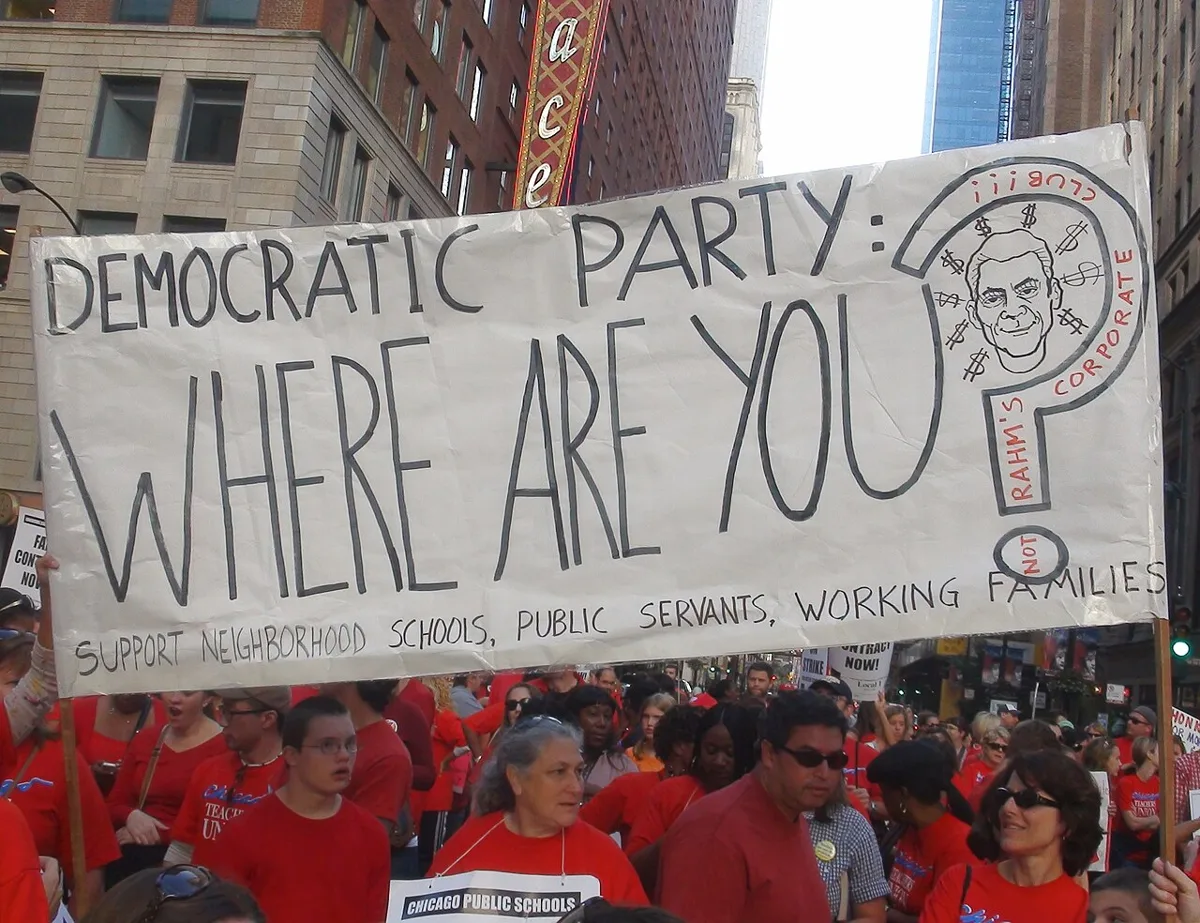
A major new report on Democratic coalition politics has found exactly what you suspected but nobody in a party leadership meeting will say out loud: the Democratic Party has been comprehensively taken over by the priorities of wealthy, college-educated professionals, and working-class voters have noticed. Of the top 12 political priorities listed by working-class survey respondents, 11 were economic concerns. The Democratic donor class, meanwhile, ranked "resisting authoritarianism" above protecting Social Security. These are not the same party.
The Report They Needed to Read Five Years Ago
The research comes from Jared Abbott, director of the Center for Working Class Politics, and Joan Williams, author of Outclassed: How the Left Lost the Working Class and How to Win Them Back. Their new report, titled The Left's Coalition Crisis: Understanding the Massive Divide Between Working Class and College Educated Voters, and How to Bridge It, is being described by the authors as the most comprehensive review available of class-based political attitudes across a range of issue areas.
According to The Guardian, they built an original survey to measure attitude gaps between two distinct groups: the broad working class, defined as non-college-educated, middle-income workers, and the liberal upper middle class, defined as Democratic-leaning college graduates with household incomes in the top 25%. The gaps they found were not subtle. They were not nuanced. They were, in the clinical language of social science, enormous.
Eleven Out of Twelve Economic Priorities. The Party Is Talking About Vibes.
Here is the number that should end careers: working-class respondents listed economic concerns as 11 of their top 12 political priorities. The only non-economic issue that cracked their top 12 was reducing crime. Jobs, wages, economic growth, affordable housing, healthcare costs. That is what working-class voters want to talk about.
The educated upper-income Democrats in the survey? Only six of their top 12 priorities were economic. They prioritized, in the words of The Guardian's coverage of the report, "resisting authoritarianism" above protecting Social Security, and "ending racism" above protecting Medicaid. These are real findings from a real survey. Sit with that for a moment.
None of this is to say that authoritarianism and racism are not serious problems. They absolutely are. But when a party's primary electorate is ranking abstract ideals over concrete material benefits, and then wondering why working-class voters feel condescended to, something has gone profoundly wrong with the feedback loop.
The Primary System Is the Engine of This Problem
Democratic primaries are dominated by college-educated, upper-income voters. This is not a secret. And as The Guardian reports, because those voters drive the primary process, their cultural and symbolic priorities have essentially come to define what liberalism means in this country. Not as a fringe influence. As the main event.
What that produces, as Abbott and Williams lay out, is a party whose public appeals are calibrated to generate applause in rooms full of people who are, statistically, more economically comfortable than the voters the party theoretically exists to represent. The Guardian notes that college graduates in both Europe and the United States are documented to show more bias against the less-educated than against any other stigmatized group, including racial, religious, and sexual minorities. The working class has picked up on this. They are not stupid.
The cultural signaling that plays well in those rooms, the performative declarations of solidarity, the carefully worded commitments to not "throw X group under the bus," carries a real cost. As the report argues, it tells working-class voters that their concerns are not just secondary but that the people making these speeches either do not understand their lives or actively look down on them.
Even on Economics, the Two Classes Are Talking Past Each Other
You might think that if the party just stopped doing the culture war stuff and focused on economics, the problem would solve itself. The report says: not exactly. Even on economic terrain, the class divide produces different priorities.
The Guardian's coverage explains that college-educated, upper-income voters are primarily preoccupied with the cost of things they buy. This makes sense given their position in what the report calls a K-shaped economy, where educated workers in corporate and professional careers participate in the economy mainly as consumers. They drive, according to the report, nearly 60% of all consumer spending despite being in the top 20% of the income distribution. Prices matter enormously to them.
Working-class voters care about prices too, but for a fundamentally different reason. For them, the crisis is about work: wage stagnation, the disappearance of good stable jobs, the devaluing of labor itself. These are not the same problem with different vocabulary. They are different problems. And the policy solutions that flow from each diagnosis, on trade, on immigration, on industrial policy, can point in opposite directions.
The Tariff and Immigration Traps
This is where things get genuinely uncomfortable for a significant chunk of Democratic economic orthodoxy. The Guardian reports that some liberal appeals to "affordability" specifically emphasize scrapping tariffs and embracing more liberal immigration rules as mechanisms for broadening consumer demand and lowering costs. This is the free-trade consensus that dominated Democratic economic thinking for decades.
Working-class voters, the report finds, are skeptical of this framework. And not without reason. Trade liberalization and loosening labor supply through immigration may benefit consumers broadly, but the workers who bore the brunt of manufacturing collapse in the 2000s experienced those policies as a direct attack on their livelihoods. Telling those voters that free trade is good, actually, because your groceries will be slightly cheaper, is not a winning message. It is an insult dressed up as economics.
This is the full trap the party has built for itself. The cultural appeals don't work. The economic framing doesn't fully connect. And the policy solutions the donor class prefers actively antagonize the voters the party needs.
The Dingo Take
The Democratic Party has a consulting class problem, a donor class problem, and a primary voter problem, and they all feed the same beast. Wealthy, college-educated professionals are not wrong to have political preferences. They are wrong to run a party that is supposed to represent working people while treating those people's actual priorities as embarrassing electoral inconveniences to be managed or educated away. That is not a coalition. That is a book club that occasionally needs to win elections.
What makes this report stinging is not that the findings are shocking. It's that they are obvious to anyone who has spent time talking to working-class voters rather than writing memos about them. Eleven out of twelve economic priorities. That number represents a complete failure of political listening, sustained over years, that handed Donald Trump a map and a torch. The party's response, largely, has been to argue about which lane of the highway to drive in while the bridge is out.
The fix, if there is one, requires the party to do something structurally difficult: tell its most engaged, most financially generous, most culturally confident voters that their priorities are not the only priorities that matter, and then actually mean it in policy terms. That means running on jobs and wages even when it bores the donor dinner crowd. It means shutting up about the abstract stuff long enough to talk about Medicaid with the same urgency as authoritarianism. Whether there is anyone in Democratic leadership right now with the spine to do that is, at this point, genuinely unclear.





Comments