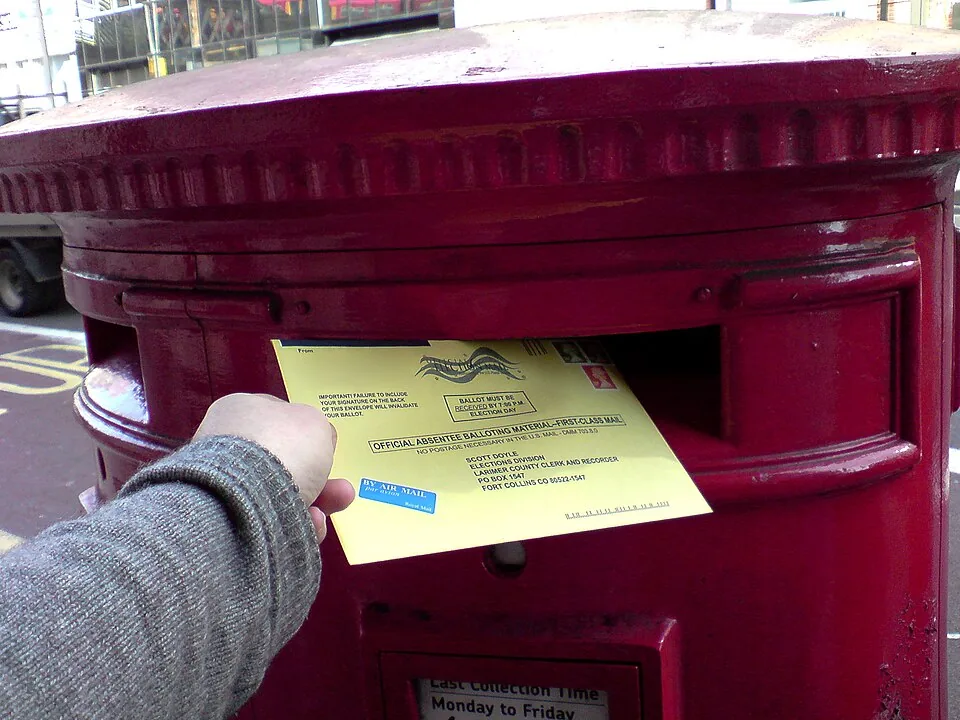
A federal judge in Boston just handed Donald Trump a significant win in his ongoing crusade against mail-in voting, clearing the way for the U.S. Postal Service to start carrying out the president's executive order ahead of the midterms. The same judge who had blocked the whole operation reversed herself Wednesday, citing the Supreme Court's earlier procedural ruling. And now the highest court in the land may have to weigh in again, this time on the actual merits of whether any of this is legal.
What the Judge Actually Did
U.S. District Judge Indira Talwani, a federal judge in Boston, had previously issued a nationwide ruling blocking the Postal Service from working on Trump's directives. On Wednesday she canceled that ruling entirely, according to NPR. Gone. Done. The USPS is now free to move forward.
The reasoning traces back to the Supreme Court, which earlier halted a separate Talwani ruling that applied to 23 mainly Democratic-led states and Washington, D.C. that sued over the order. The high court's logic was narrow and procedural: Talwani weighed in too early, before the USPS had put out a finalized plan. So she waited. USPS released its final rule on August 21. And then Talwani, following the Supreme Court's lead, stepped aside.
This is not a ruling on whether Trump's order is constitutional. The Supreme Court itself has not touched that question yet. What we have right now is a cleared runway, not a green light. The legal fight is very much alive.
The Rule That Makes This Controversial
The USPS final rule, released August 21, contains one provision that is the heart of the entire fight. As NPR reports, the rule lays out a plan to deliver mail-in ballots only to people on lists of absentee voters that states would have to hand over to the postal agency. That is a significant shift in how mail voting works, and it hands the federal government a new chokepoint in a process that has historically been managed by the states.
Trump signed the original executive order back in March, claiming it was designed to stop illegal voting by non-citizens. Multiple studies and audits have found that non-citizen voting is extremely rare. Trump has, for the record, voted by mail himself in Florida. More than once.
The challengers, a coalition including Democrats, voting rights groups, and two dozen mostly Democratic-led states, argue this is a straightforward constitutional violation. The Constitution hands the power to set federal election rules to the states and Congress, not the president. They also argue USPS has no legal authority to control mail-in voting at all. These are not fringe arguments. These are the arguments.
Where This Goes Next
The legal fight is not over. Not remotely. Challengers are now asking Talwani, and a separate federal judge in Washington, D.C., to issue new rulings blocking USPS from carrying out its finalized plan. Whatever those judges decide will almost certainly be appealed. The trail leads back to the Supreme Court, which will eventually have to rule on the actual substance of whether Trump's order is legal, something it has deliberately avoided doing so far.
The midterms are weeks away. Mail-in voting is expected to start soon. The timing here is not incidental. It is the whole ballgame. Every day the order stands, states and voters have to plan around it. Every ruling, every appeal, every procedural twist moves the clock closer to an election being run under rules that a federal court has not yet validated.
As NPR reports, it remains genuinely unclear if and how Trump's directives will ultimately affect mail voting for the midterms. That uncertainty, at this stage of election prep, is itself a form of disruption.
The Stakes Are Not Abstract
Mail-in voting is not a niche preference. Tens of millions of Americans vote by mail every election cycle. Elderly voters rely on it. Disabled voters rely on it. Rural voters rely on it. Military families abroad rely on it. Any rule that introduces new friction, new requirements, or new gatekeeping into that process does not affect everyone equally.
The specific mechanism in the USPS rule, delivering ballots only to people on state-provided absentee voter lists, creates a new dependency on states to share data with a federal agency on a tight timeline. States that refuse or fail to comply in time would effectively have their mail voters shut out. That is a feature of this plan, not a bug, depending on who you ask.
Democratic-led states have every reason to resist. Republican-led states have every reason to cooperate. The result is a patchwork where your ability to vote by mail in the 2026 midterms may depend entirely on which state you live in and whether your governor felt like playing ball with the Trump administration. Welcome to American democracy, 2026 edition.
The Dingo Take
Trump voted by mail. He voted by mail in Florida. Multiple times. He signed an executive order in March to restrict mail-in voting for everyone else while he himself has used the exact system he is now trying to dismantle. That fact deserves to live rent-free in your brain every single time you read a story about this legal fight, because it tells you everything about what this is actually about. It is not about election integrity. It is about who gets to vote.
The constitutional argument against this order is not complicated. States and Congress set federal election rules. That is what the Constitution says. An executive order from the president cannot simply override that architecture, no matter how many lawyers USPS puts to work writing a final rule. The Supreme Court has been careful to avoid saying this out loud, hiding behind procedural objections while the midterms close in. At some point they have to answer the actual question. That point is coming fast.
What is genuinely alarming is how normalized this has become. A president issues an order to reshape how Americans vote. Courts block it, partially, temporarily. The Supreme Court steps in on a technicality. A new rule drops. Judges reassess. And meanwhile, election administrators across the country are trying to figure out how to run an election under rules that may or may not be legal, with weeks to go. This is not governing. This is arson with extra steps.

Comments