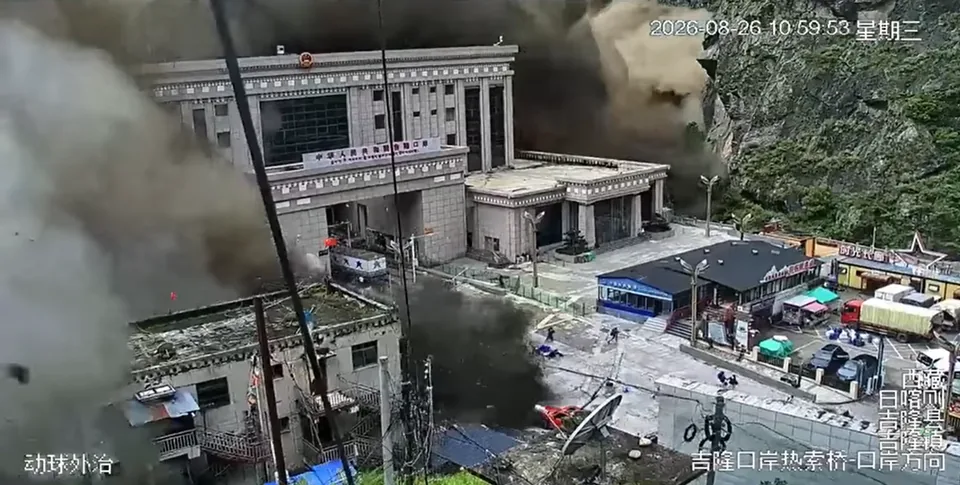
A wall of mud moving at 40 miles per hour buried entire families alive in Nepal and Tibet this summer, and the death toll has now passed 900 with more than 4,400 people still missing. This was not a freak accident, a bad season, or a random tragedy. According to climate scientist Michael Mann, writing in the Guardian, this was a glacier structurally failing because the planet is too warm to hold it together anymore. We did this.
What Actually Happened Up There
For millennia, the Himalayas were held in place by permafrost and glacial ice, essentially frozen glue binding ancient rock into stable mountain faces. As the Guardian reports, human-caused planetary warming is liquefying that glue. What followed was not a flood in any conventional sense. It was a structural failure of a mountain.
Surveillance footage captured the moment a churning mass of mud and debris, described by witnesses as "liquid concrete," overtook people trying to flee. Entire families disappeared in seconds, buried under feet of thick red-soaked silt. The torrent was the direct result of warming-induced glacial collapse, which dumped millions of tons of rock and unleashed a high-velocity wave across populated valleys below.
As CNN framed it, and Mann quotes approvingly in the Guardian: living downstream from a glacier has become a deadly liability. That is not hyperbole. That is the new operating reality for hundreds of millions of people across South Asia.
"But Can You Actually Blame Climate Change?" Yes. Sit Down.
Here is the part where, in a healthier media environment, we would not need to spend three paragraphs pre-debunking the inevitable "you can't attribute any single event to climate change" deflection. But here we are.
Mann lays it out in the Guardian using what scientists call attribution science, which works by running parallel climate simulations, one representing a world without human industrial emissions and one representing the actual world we built. Researchers compare how often a given extreme event occurs in each scenario. If the event is dramatically more likely in the real-world simulation than the counterfactual one, you can attribute the event's severity to human-caused warming. It is the same statistical framework we use to say smoking causes lung cancer. A lifetime smoker is up to 30 times more likely to get lung cancer. We do not say the cigarettes "might have contributed."
In the case of the Nepal disaster, there is no statistical ambiguity at all. The mechanism is direct and physical: warming melts glacial ice, destabilizes mountain faces, collapse follows. You want a smoking gun? The glacier is the smoking gun. It's just not frozen anymore.
This Was the Exclamation Point on a Summer-Long Horror Show
The Nepal collapse did not happen in isolation. It was, as Mann writes in the Guardian, the exclamation point on a summer of extremes that started months earlier and never really let up.
It began with a March heat dome in the southwestern United States that produced temperatures climate scientists called "virtually impossible" without human-caused warming. Then a midsummer-like May heat dome broke records in Philadelphia. Then a European heat dome brought triple-digit temperatures to large parts of France, killing more than 3,000 people in Paris alone and nearly 6,000 across the country. That was, the Guardian reports, just the first of four consecutive record-breaking heatwaves in Europe this summer. By summer's end, those heatwaves had killed more than 35,000 people across the continent.
Thirty-five thousand people. In one summer. From heat. This number deserves to sit on its own for a moment before we move on.
The heat and drought also drove catastrophic wildfires across France and Spain that forced hundreds of thousands from their homes and generated the kind of apocalyptic imagery that goes viral for a day before everyone forgets about it. Back in the United States, Canadian wildfires pushed smoke over the eastern seaboard for weeks, with air quality hitting hazardous levels in multiple major cities. Then in mid-August, a historic derecho, a fast-moving wall of severe thunderstorms with winds exceeding 100mph, swept from Illinois to Virginia and knocked out power for nearly a million people. All of it, Mann writes in the Guardian, connected to rising carbon pollution and a warming planet.
Who Gets to Decide This Is Acceptable
Here is a useful comparison. If a corporation dumped a chemical into a river and 35,000 Europeans died over one summer, and 900 people were killed in an Asian country with 4,400 still unaccounted for, we would call that a crime. There would be prosecutions. There would be asset seizures. There would be congressional hearings that, for once, nobody skipped.
Instead, the fossil fuel companies that have spent decades funding climate denial, lobbying against emissions regulations, and privately documenting exactly what their products would do to the planet are still posting record profits. Their executives are still giving commencement speeches. Their lobbyists are still writing energy policy.
The science, as Mann makes clear in the Guardian, is not complicated at this point. The only complicated part is figuring out how the wealthiest and most powerful industries in human history have successfully reframed "stop burning fossil fuels before you kill tens of thousands of people per summer" as a radical political position.
The Dingo Take
You are supposed to look at 35,000 heat deaths in Europe, 900 bodies recovered from a Himalayan mud torrent, and nearly a million Americans without power from a single storm, all in one summer, and conclude that this is a policy debate with two reasonable sides. You are supposed to hear "virtually impossible without human-caused warming" from climate scientists and file that under "contested claim." You are supposed to keep treating this as a topic for balanced panel discussions while the planet structurally fails in real time.
That framing is a lie, and at some point the death tolls make continuing to pretend otherwise genuinely obscene. The Guardian's reporting makes clear that climate attribution science has moved well past the point of statistical ambiguity. These are not events that climate change made slightly worse. These are events that climate change made possible, or directly caused. The Nepal glacier did not collapse because of a bad monsoon season. It collapsed because the frozen glue holding a mountain together has been melting for decades because of choices made by identifiable people and institutions.
The next time someone tells you we need to "balance economic concerns" against climate action, remember that the accounting already happened. The bill came due this summer. It was paid in mud and fire and 35,000 bodies in Europe alone. And next summer, absent dramatic and immediate action, the invoice will be larger.





Comments