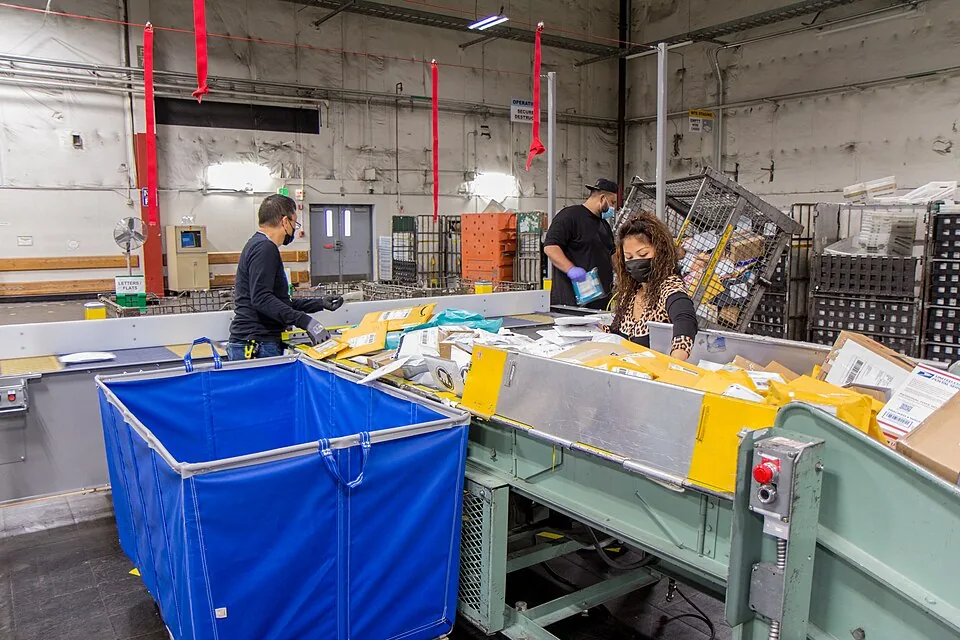
Someone inside the United States Postal Service watched the agency build a ballot-screening system designed to protect election integrity, realized it could accidentally nuke tens of thousands of legitimate votes in a single scan, and decided the American public probably should know about that. A whistleblower has gone to Congress with exactly that warning, and what they described is genuinely alarming — not just as a voting rights issue, but as a portrait of a federal government in full, reckless sprint toward an election it is actively trying to control.
Zero Percent Failure Rate Means One Mistake Kills Entire Batches
Here is the core of what the whistleblower told Congress, as reported by The Guardian: the USPS system — officially called the "Federal Ballot Mail Portal" — operates on a zero percent failure rate. Officials upload voter and barcode data in advance. Postal clerks then scan a sample of incoming ballots, anywhere from 15 to 400, against that federal list. If even one scan mismatches, the entire batch gets rejected. The entire batch. Which could contain tens of thousands of ballots.
That is not a bug they are working to fix. That is the design. The system treats a single scanning glitch the same way it would treat a truckload of fraudulent ballots — by throwing everything out. You could have 49,999 perfectly valid ballots sitting next to one barcode that scanned wrong on a Tuesday afternoon, and the whole pile goes in the trash. This is the system the Trump administration is rushing into service weeks before the 2026 midterms.
Senator Richard Blumenthal, the top Democrat on the Senate's permanent subcommittee on investigations, disclosed the whistleblower's account in a letter to Postmaster General David Steiner on Tuesday. He did not mince words: USPS, he wrote, "lacks the technical or operational capability" to roll this out safely before ballots land in voters' hands.
Three Months to Build What Normally Takes a Year
The timeline here is what should make your jaw drop. According to The Guardian's reporting on the whistleblower disclosure, engineers had roughly three months to build a system that would normally require close to a year of development. That three months included a court-ordered pause, meaning the actual working window was even shorter. The full system was not assembled for testing until approximately August 24th — leaving a grand total of a few business days to find problems before launch.
By the final week, people inside the project were reportedly calling it "a shit show." That is a direct quote attributed to officials within the effort. One worker who raised concerns about the lack of testing time was told, simply: "We cannot fail." Not "you're right, let's fix it." Not "we'll delay until it's ready." Just a declaration that failure was not permitted, as though saying it out loud would make the software work correctly.
This is the USPS equivalent of building a bridge in three months, skipping the stress tests, and then telling the engineer who noticed the cracks that failure is not an option. The bridge does not care. The code does not care. Midterm elections are not optional either, but apparently that concern is ranked somewhere below the administration's desire to get this thing running before November.
Where This System Even Came From
The Federal Ballot Mail Portal exists because of a March executive order from Trump that dramatically expanded federal control over mail-in voting. The Guardian reports that the order directed USPS to screen ballots against a federally approved voter list before delivering them, which is a sharp break from the agency's historical role of simply delivering whatever state and local election officials hand over. Courts have been fighting over it ever since, blocking and unblocking parts of the order repeatedly as lawsuits pile up arguing it stomps on constitutional authority that belongs to the states.
About a third of all voters cast ballots by mail in 2024. That is not a fringe group of people the administration can afford to disenfranchise quietly. These are tens of millions of Americans whose votes would flow through a scanning system that, by the account of someone who worked on it, was not even fully assembled until a week before it was supposed to go live.
Representative Robert Garcia, the top Democrat on the House oversight committee, told The Guardian his panel had received similar reports. Garcia called it a "secret tracking system" that is "faulty, untested, and threatens to totally disrupt ballot delivery for millions of American citizens." He went further, describing the whole effort as an "unconstitutional and dangerous power grab," which is a phrase that is starting to lose its shock value in 2026 but still earns it here.
They Built It While Courts Told Them to Stop
The part of this story that deserves its own flashing warning light: Blumenthal's letter alleges USPS kept building the portal even while under active court orders to halt the work. The Guardian reports the senator wrote that "USPS should have ceased all work on the Portal on June 25, 2026," and that a court order issued on August 27th that explicitly told them to stop is still in effect.
So the agency reportedly ignored a court order in June, kept building, and then received another stop order on August 27th. The full system was assembled for testing on approximately August 24th. Do the math on that sequence. They rushed to finish before the new stop order hit, and now they are sitting on a completed but barely-tested system under a court order that says they should not have built it.
Blumenthal has given USPS until September 4th to answer who ordered the work to begin and resume under those court orders, and until September 8th to hand over internal records. USPS has not publicly disclosed an expected rejection rate. The whistleblower says that number was deliberately withheld because revealing it would expose just how shaky the rollout actually is.
What Happens If This Goes Live
The whistleblower's prediction of mass disruption remains unconfirmed, according to The Guardian — the system had not gone live as of this week. That is the one small piece of good news buried in this story. There is still technically time to stop this, or for a court to stop it, or for USPS to acknowledge what its own workers are telling Congress.
But "still technically time" is doing a lot of heavy lifting in that sentence. Election officials across the country are weeks away from sending out mail-in ballots. The logistics of administering an election do not pause while federal agencies and courts sort out whether their new scanning software is ready. Every day this remains unresolved is a day that states cannot plan, cannot test contingencies, and cannot tell their voters with confidence that their ballots will actually be delivered.
Blumenthal put it plainly in his letter to Steiner: "The Trump Administration appears intent on USPS moving forward with its flawed plans, no matter the chaos they may create." That phrase, "no matter the chaos they may create," is the honest summary of where we are. The chaos is not an accident. It is the predictable output of a system designed and built at sprint speed by an agency that was told it cannot fail, and which appears to have responded by hiding evidence that it already has.
The Dingo Take
You are supposed to believe this is about election integrity. The Trump administration has spent months arguing, with a straight face, that the Federal Ballot Mail Portal exists to protect American voters from fraud. And then it built the thing in three months, skipped most of the testing, ignored at least one court order telling it to stop, and designed the rejection logic so that a single scanning error on a Tuesday afternoon can invalidate a batch of 50,000 legitimate votes. That is not a system designed to catch fraud. That is a system designed to fail in ways that are catastrophically convenient.
The whistleblower who went to Congress is describing exactly what suppression looks like when it wears a technical uniform. It does not need to announce itself. It just needs a zero percent failure rate, a rushed rollout, and a postmaster general who does not answer letters from senators until legally forced to. The rejected ballots do not come with a sign explaining they were thrown out by a glitch. They just do not count. The voters whose ballots vanish into that gap never know. That is the whole point.
Thirty-three percent of American voters mailed their ballots in 2024. Thirty-three percent. Whatever happens next — in court, in Congress, in the final days before this thing goes live — the stakes are not abstract. We are talking about a system that its own builders reportedly called a shit show, deployed by an administration that responded to concerns by saying failure is not an option. Failure, it turns out, has opinions of its own.



Comments