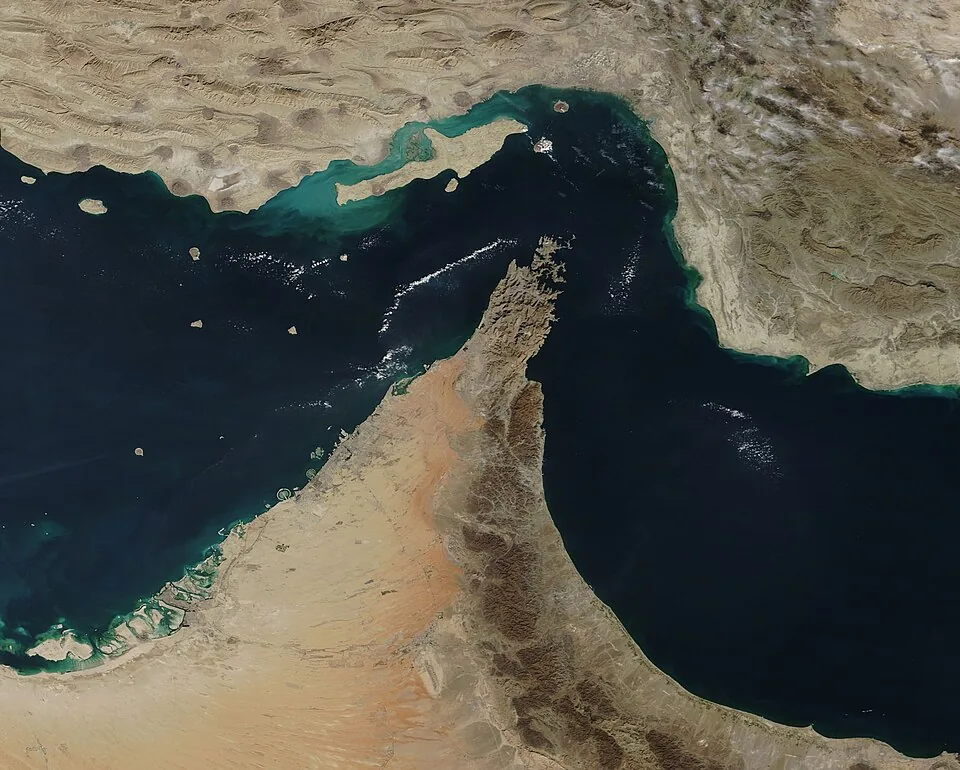
Iran just announced it's planning to declare an "exclusion zone" around the Strait of Hormuz, the narrow waterway that roughly 20% of the world's oil passes through, after the U.S. military sank three of its tankers over the weekend. Gas is already at $4.14 a gallon heading into Labor Day, a record high for the holiday. The bill for this war is arriving at every pump in America, and nobody has any idea how high it goes from here.
What the U.S. Actually Did This Weekend
U.S. Central Command confirmed Saturday that American forces had "permanently disabled" three Iranian oil tankers in the Persian Gulf and the Gulf of Oman. That's the military's way of saying they sank them, or came close enough that it doesn't matter.
The strikes were framed as retaliation for Iran targeting American warships with ballistic missiles, which was itself retaliation for earlier U.S. strikes. Admiral Brad Cooper, the CENTCOM commander, put it bluntly in a statement reported by CBS News: "If you shoot at two of our ships, we will impose an even higher economic cost, taking out three of yours."
There is something almost sports-scoreboard about the logic of that statement. You hit two of ours, we hit three of yours. Except the scoreboard is a war in the Persian Gulf, and every escalation is getting written into the price of gas in Topeka.
Iran's Response: We're Done Being Proportionate
Tehran did not take the tanker strikes quietly. Mohammad Bagher Ghalibaf, the speaker of Iran's Parliament, went on state media Sunday and made a threat that should probably get more attention than it's receiving.
"The Americans must have understood that the era of proportionate responses has come to an end," Ghalibaf said, according to CBS News. "Any aggression against Iran's interests and security will receive a faster, more intense and more painful response."
That is not boilerplate tough talk. That is a government officially announcing it is abandoning the informal rules that have kept this conflict from going fully off the rails. When a state actor explicitly says proportionality is over, you should probably believe them.
The new head of Iran's Supreme National Security Council, Mohsen Rezaei, followed that up by announcing plans for a formal "exclusion zone" outside the Strait of Hormuz. The zone, he told state broadcaster, would run from the U.S. naval blockade line toward the strait and into the Persian Gulf. Details are thin. The threat is not.
The Strait of Hormuz Is the World's Most Dangerous Chokepoint, Now Being Actively Fought Over
Here is the geographic reality everyone needs to understand. The Strait of Hormuz is roughly 21 miles wide at its narrowest point. Saudi Arabia, the UAE, Iraq, Kuwait, Qatar — most of their oil exports pass through it. Before this conflict, roughly one in five barrels of oil traded globally moved through that waterway.
Crude oil traffic through the strait has already "plunged" since the U.S. and Israel attacked Iran in February, according to the Associated Press. Iran has refused to reopen it. Now Tehran is threatening to formalize that blockade with an exclusion zone that gives it legal cover to stop vessels it deems unauthorized from passing at all.
An exclusion zone sounds bureaucratic. It isn't. It's Iran saying it will treat any ship attempting to transit the strait without its permission as a legitimate military target. The world's oil supply does not have a good alternate route for this volume of traffic. There is no "we'll just go around" option at scale.
The Price of All This, At the Pump
Brent crude, the international benchmark, hit $96.95 a barrel on Sunday, up another 67 cents just in that trading session, according to CBS News. The psychological $100 barrier is close enough to taste.
On the ground, AAA reports that regular gas averaged $4.14 a gallon heading into Labor Day weekend. That's nearly a dollar higher than last year, and it smashes the previous Labor Day record of $3.82, set back in 2012. Americans are paying record prices to fill their tanks before a holiday road trip, in a conflict most of them couldn't find on a map two years ago.
Prices shot up after the U.S. and Israel struck Iran in February, and as CBS News reports, they have not settled down since. They will not settle down while the Strait of Hormuz is a live combat zone. That much is not complicated.
The Escalation Ladder, and Where It Goes Next
The pattern here is not hard to read. Iran fires on U.S. warships. The U.S. sinks Iranian tankers. Iran threatens more painful retaliation and moves to formally cut off the world's most important oil shipping lane. Somewhere in there, someone miscalculates, or someone decides that backing down is politically impossible, and the next step is a strike on something that can't be walked back.
The Trump administration has been explicit about its posture. Admiral Cooper's statement, that the U.S. will "not hesitate to defend American forces" and will "destroy Iran's limited and exposed oil fleet" if necessary, sets a very short fuse. That's not a diplomatic statement. That's a promise of further escalation delivered as a press release.
What happens when Iran makes good on its own promise of a "more intense and more painful" response? What does that look like? At what point does this tit-for-tat logic terminate in something that closes the strait permanently, or pulls in another regional actor, or forces a choice nobody wants to make publicly?
The Dingo Take
You are supposed to believe that $4.14 gas on Labor Day is just a market fluctuation. A temporary disruption. The kind of thing that sorts itself out. You are supposed to keep driving to your barbecue and trust that adults are handling the situation in the Persian Gulf.
They are not handling it. What is happening is a live-fire escalation cycle between the U.S. military and a government that just announced, on state television, that proportionate responses are over. The Strait of Hormuz, through which a fifth of the world's oil moves, is now a declared conflict zone with an exclusion zone coming. Brent crude is knocking on the door of $100 a barrel. This is not a price spike. This is the opening act of what happens when the world's oil infrastructure becomes a battlefield.
The administration wanted a confrontation with Iran. They got one. What they do not appear to have is any coherent answer to what comes next once every escalation generates a counter-escalation and the world's most critical shipping lane gets closed by a government that has nothing left to lose economically. The $4.14 you paid at the pump this weekend is not the ceiling. Not even close.



Comments