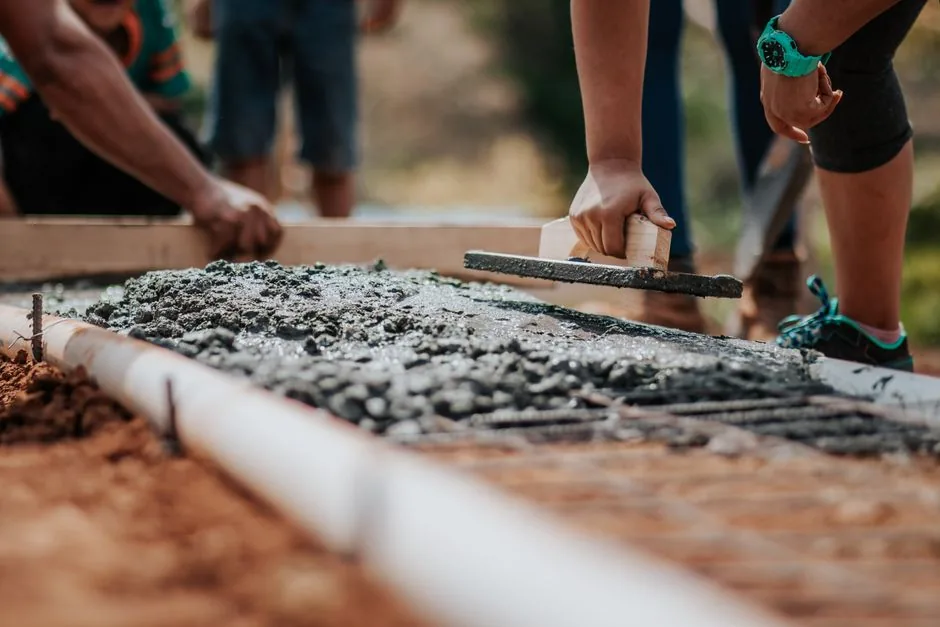
Researchers in India have made concrete out of processed human feces, and it is stronger than regular concrete. Not slightly stronger. Forty-two percent stronger in one key measurement. The future of global infrastructure may literally be built on your contributions to it.
The Problem With Concrete, Which Is Holding Up Everything
Concrete is, as ScienceAlert puts it, quite literally the foundation of the modern world. Almost every construction project on earth uses it in some form. The catch is that making cement, the active ingredient in concrete, is an environmental catastrophe. Heating and processing limestone to make cement is one of the planet's largest single sources of carbon dioxide emissions.
So scientists have been chasing substitutes for years. Wood biochar. Rice husk biochar. Sawdust biochar. All carbon-rich materials made by heating organic matter in a low-oxygen environment. They work reasonably well. And then someone looked around and said: wait, what else do humans produce in absolutely enormous quantities every single day?
Enter the Poop
A team led by civil engineer Raghuvesh Tiwari of Manipal University Jaipur in India obtained fecal sludge biochar from a treatment plant in Warangal, ground it into a fine powder, and used it to replace 5, 10, and 15 percent of the cement in standard concrete mixes. The paper has been accepted for publication in Scientific Reports.
The production process is not glamorous but it is real. Fecal sludge is dried, heated to between 350 and 450 degrees Celsius in a low-oxygen environment through a process called pyrolysis, and ground into powder. That powder then goes into your building. Or, eventually, it might.
For reference, ScienceAlert reports that humans produce up to around 400 grams of poop per person per day. Multiply that across several billion people and you have a raw material supply problem that is, to put it gently, already solved.
The Numbers Are Genuinely Insane
After 91 days of curing, the 5 percent poop biochar mix showed average increases of 20 percent in compressive strength and 36 percent in flexural strength compared to ordinary concrete. Push the replacement up to 10 percent and flexural strength gains hit 42 percent. That is not a rounding error. That is a structural engineering finding that should be on the front page of every newspaper that isn't currently on fire about something else.
The poopcrete also performed better on water absorption and porosity at the 5 percent level, absorbing less water and showing lower porosity than standard mixes. At 10 percent, performance stayed broadly comparable to ordinary concrete. At 15 percent, the researchers found the structure starting to degrade under a microscope, more pores, more cracks, more poorly bonded regions. So yes, there is such a thing as too much poop in your building. Good to know where the line is.
Why Poop Actually Works Here
The science behind this is legitimately interesting. According to ScienceAlert's reporting on the study, poop biochar is highly porous at a microscopic level, full of tiny cavities that absorb water and release it slowly as the concrete cures. This turns each biochar particle into a miniature internal reservoir, keeping moisture available for the chemical reactions that harden cement longer than it would otherwise be available.
But the fecal contribution does not stop at water management. The biochar is also rich in silica, which reacts with compounds produced during curing to form more calcium silicates, the compounds that give concrete its fundamental strength. The researchers describe this as pozzolanic, the same category of chemistry the ancient Romans exploited to build structures that have lasted two thousand years. The Romans used volcanic ash. These researchers used what humans make roughly 400 grams of per person per day. Innovation takes many forms.
At 5 percent replacement, the researchers could actually see the difference under a microscope. The poopcrete had a denser, more tightly bonded internal structure than conventional concrete. At 15 percent, that dense structure gave way to visible cracks and gaps. Five to ten percent is the sweet spot.
The Two Birds, One Stone Situation
This is worth pausing on, because the research is addressing two serious problems simultaneously. Cement production is a climate disaster. Human fecal waste is, depending on where you live, an infrastructure and public health disaster. In India specifically, fecal sludge treatment plants exist precisely to manage the massive volumes of human waste that would otherwise contaminate water supplies and spread disease.
By converting that waste stream into biochar and feeding it into the construction supply chain, the research team has sketched out a potential loop where an environmental liability becomes a structural asset. The concrete gets stronger. The waste gets managed. Cement production potentially gets reduced. Nobody is claiming this scales overnight, and Tiwari's team is not suggesting we start building skyscrapers out of poopcrete tomorrow. But the direction is clear.
The Dingo Take
You are supposed to believe that the defining infrastructure challenge of the 21st century is a funding problem, a political will problem, a technology problem. And sometimes it is all of those things. But occasionally science produces a result so blunt it almost feels like a joke at civilization's expense: you wanted better concrete, you had the raw material the whole time, you were flushing it.
The cement industry accounts for somewhere between 7 and 8 percent of global CO2 emissions depending on whose estimate you use. That is a staggering number for a single material category. And the global population is producing hundreds of millions of tons of fecal sludge annually, much of it managed badly or not at all, particularly in lower-income countries where construction demand is also highest. The overlap here is not subtle.
This research comes out of India, from a university team, using a treatment plant in Warangal as its source. It will almost certainly not get the attention it deserves because it involves poop and therefore the coverage will be giggly and shallow and then forgotten. But a 42 percent improvement in flexural strength using a waste product that is also a public health hazard is not a punchline. It is one of the more useful scientific findings published this year. Someone build something with it.




Comments