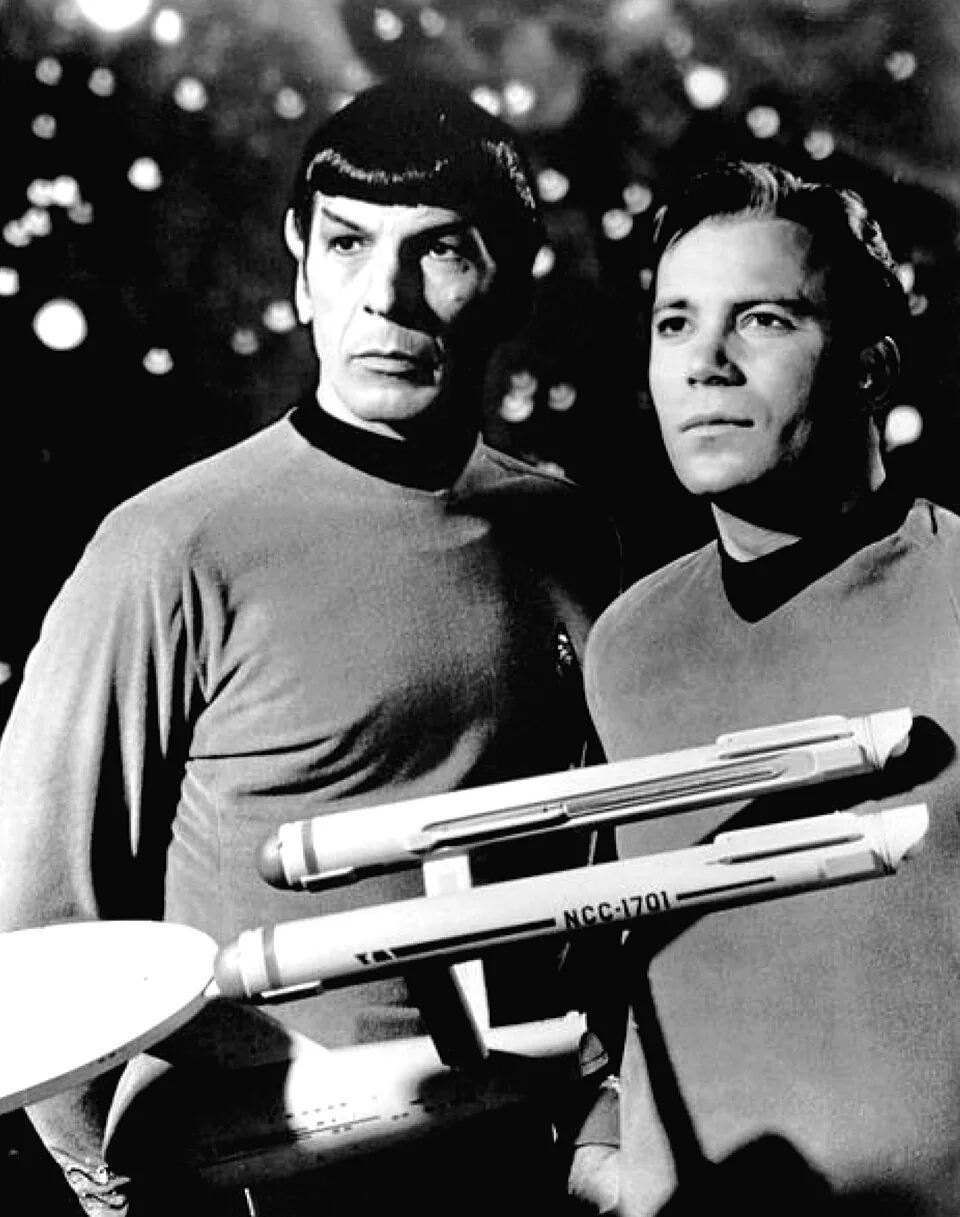
Star Trek turned 60 last week, and the party favor is a void. According to NPR, there are currently no new Star Trek TV series or movies definitively announced, and if that doesn't change soon, 2027 could be the first year in roughly a decade with nothing new in production. Happy birthday, I guess.
Sixty Years of Boldly Going, and Now... Parking
The original series debuted on NBC on September 8, 1966. Three seasons. William Shatner as Kirk. Leonard Nimoy as Spock. A Black woman on the bridge, a Russian at navigation, a Japanese helmsman, all during the Cold War, during Vietnam, during assassinations and riots and a country eating itself alive. The show was not subtle about what it was doing. It was a vision of survival through cooperation, dressed up as space adventure.
Six decades later, as NPR reports, the franchise has produced seven streaming-era series and a movie, conventions that basically invented the modern fan convention, video games, novels, comic books, and enough collectibles to fill a starship hangar. And now it may be about to go quiet, at least for a while.
What's Actually on the Schedule: Not Much
Here is the current situation, per NPR's reporting. The last two active Trek TV series, Starfleet Academy and Strange New Worlds, are both wrapping up their runs. A Paramount+ executive apparently told Deadline they want a new iteration of the franchise. A writing team is reportedly working on a new movie script for Paramount Pictures. But no film or series has actually been announced.
That gap matters. The streaming era has produced a near-constant flow of new Trek content since Discovery launched in 2017. Lower Decks debuted in 2020. Strange New Worlds followed. For anyone who got used to there always being something new coming, the pipeline suddenly looks empty.
The Optimism Problem
Akiva Goldsman, who co-created Strange New Worlds, told NPR that Trek's core appeal is a morality play built on a specific kind of hope. "About optimism, about exploration, about this notion that decency and kindness and empathy are the strengths of our culture," he said. "I think the world often isn't that. And I think we often yearn for that."
Which is a beautiful thing to say in the abstract. In practice, selling optimism about humanity's collective future is a harder pitch when the audience is watching democratic institutions get strip-mined in real time. Goldsman also pointed to a more structural problem with streaming itself, suggesting that viewers may simply want one or two great seasons of something and then move on, rather than the long-running relationship fans once had with a series. "This relationship that we once had with entertainment," he told NPR, "was also when there was far less entertainment."
That's a polite way of saying we are all drowning in content and nobody has the bandwidth to commit.
One Contrarian With a Blue Goatee Has a Different Theory
Ira Steven Behr, who ran Deep Space Nine for four seasons in the '90s and who NPR describes as a notorious contrarian with a goatee dyed blue, thinks the problem cuts deeper than streaming economics.
Behr's argument, as NPR lays it out, is that Star Trek was born in a specific cultural moment when people genuinely believed the world could get better through collective action, and that technology would be a benign force in making that happen. The space race was real. The moon landing happened. Progress felt possible and linear. Trek's implicit promise, that the future would be better because humans got smarter and kinder and stopped being terrible, landed in a world primed to believe it.
That world is not the current world. Whether that's a temporary crisis of faith or a fundamental shift in how people relate to utopian storytelling is the question the franchise is now sitting with, probably in a very comfortable captain's chair.
Jeri Ryan Would Like a Word
For what it's worth, actress Jeri Ryan, who joined Star Trek: Voyager in 1997 as Seven of Nine knowing almost nothing about the franchise and ended up a genuine convert, is still a believer in what it represents. She told NPR she marveled at how the original series put a Russian character on the crew during the height of the Cold War alongside a Black female officer and a Japanese helmsman.
"It was an optimistic view of what we could achieve if we stop screwing it up," she told NPR. "If we learn to appreciate and celebrate our differences and stop being afraid of everyone who is different from us." She added the word "ruefully," which tracks.
The Dingo Take
You are supposed to look at a 60-year-old television franchise going quiet for a year or two and say, so what, everything takes breaks. But there is something worth paying attention to in the specific reason Trek may be struggling to find its footing right now. It is not just a streaming business problem. It is a meaning problem. The show was built on the premise that humanity, given enough time and enough pain, would eventually grow up. That bet is looking shaky.
Goldsman is right that people yearn for what Trek sells. Behr is probably right that selling it is harder when the surrounding culture has stopped believing the product is even achievable. Both things can be true. A show premised on the idea that human decency wins in the long run requires an audience that hasn't completely given up on the long run.
Paramount will find a way to bring Trek back, because intellectual property does not sleep and neither does the merchandising revenue. The more interesting question is what version of optimism they try to sell when it returns, and whether anyone is still in the market for it. Sixty years in, the franchise's biggest challenge isn't puppets on the Enterprise or musical episodes. It's that the gap between what Trek promises and what the nightly news delivers has never been wider. That's not a cancellation problem. That's a civilization problem.




Comments