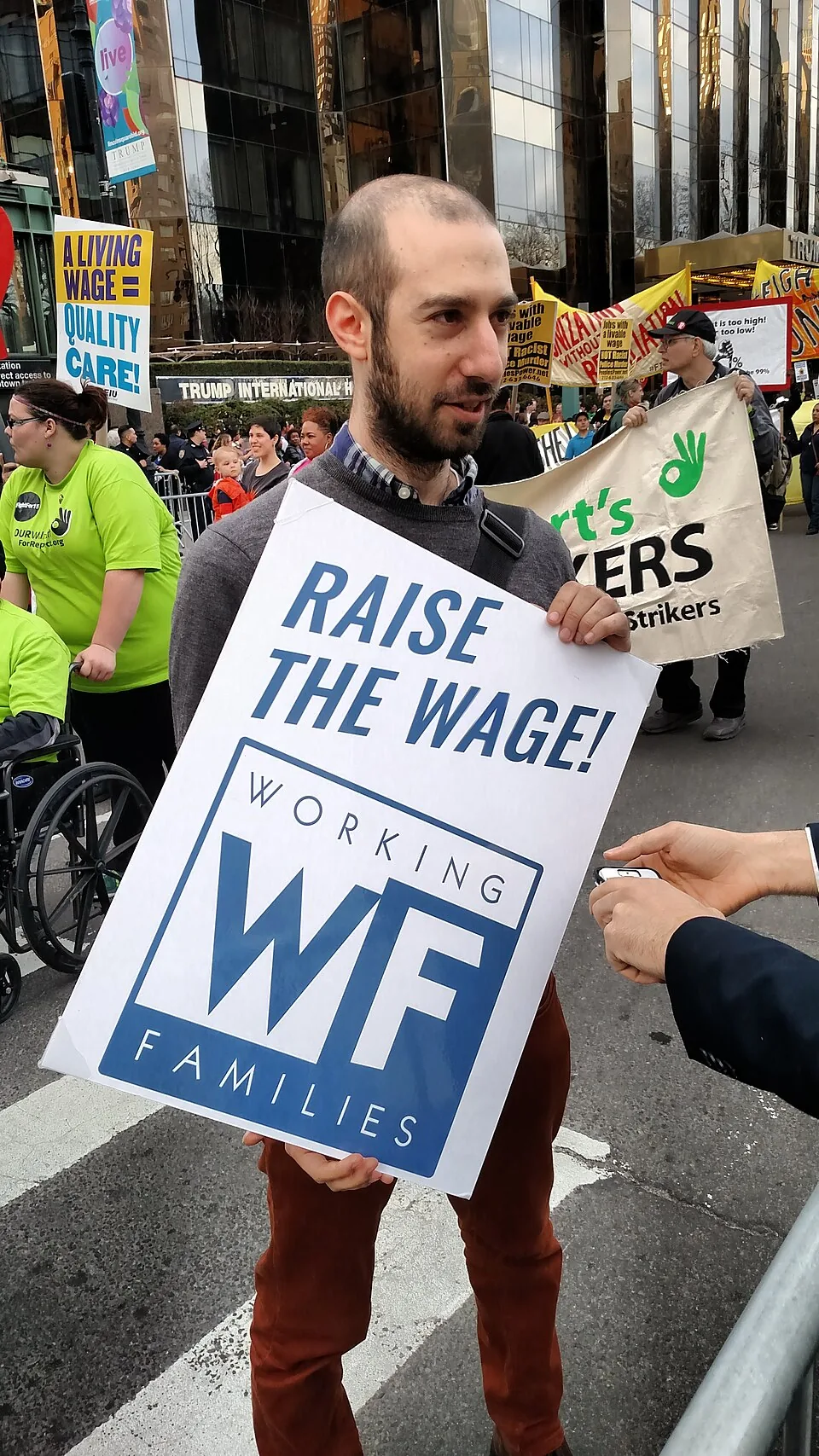
The Working Families Party's national director Maurice Mitchell put it in terms that no focus group could have workshopped: most Americans are, quote, '10 out of 10 pissed off.' As the Guardian reports after traveling across the midwest to cover contested Democratic primaries, the 2026 midterms aren't shaping up as a left-versus-right story. They're shaping up as something messier, angrier, and considerably harder to spin.
The Frame That Keeps Breaking
Every election cycle, political media tries to hand voters a clean binary. Progressive versus establishment. Trump loyalist versus RINO. Red team versus blue team. It's tidy. It books well on cable. It is also, increasingly, a lie.
The Guardian's reporting from the midwest found something that doesn't fit neatly into any of those boxes. Voters who describe themselves as moderate then turn around and rail against the entire political order. Coffee shop patrons near the Canadian border emotionally inserting themselves into reporter conversations to talk about how upset Canadians are. A 79-year-old Democratic voter in Detroit named Brian Leeland writing in to complain that framing a Senate primary as 'progressive versus establishment' is 'overly simplistic verging on lazy.'
Leeland's grievance list is long and genuinely bipartisan in its targets: grifters, liars, the two-party system, money in elections, the national debt, and a political class obsessed with culture war while ignoring material reality. He is not an outlier. He is a data point in what is becoming a very crowded trend line.
What People Are Actually Mad About
Here is the inventory, as the Guardian assembled it from the campaign trail. People cannot afford healthcare or childcare. Grocery prices are up. Gas prices are up. The richest people keep getting richer. Farmers and small business owners are getting crushed by tariffs. Small towns are fighting back against data centers and surveillance camera networks. Nobody wants more overseas wars. Women's rights and abortion access are sliding backward.
In Minneapolis, the anger over Operation Metro Surge and the killings of Renee Good and Alex Pretti is still dominating political conversations months later. That's not a policy debate. That's grief metastasized into rage, and it's looking for somewhere to go in November.
This is the environment Trump's Republican Party has to defend. Not the environment of 2020, when Republicans could credibly argue they were the disruptors. The environment of right now, where they have had power for nearly two years and the material conditions of ordinary American life have gotten measurably worse.
Trump's Anger Machine Has a Jig, and It's Up
Trump built his entire political career on this exact kind of voter fury. He understood in 2016, and again in 2024, that channeling rage at 'the establishment' was an electoral superpower. The problem, as Mitchell of the Working Families Party told the Guardian, is that you eventually have to deliver something.
'If you're claiming that the source of my pain is trans people and DEI and immigrants, and now you have the ball and you've used that power to make those people's lives hell, but my life isn't better, then the jig is up,' Mitchell said. That's not a complicated argument. That's a kitchen table argument. That's the thing someone's uncle says at Thanksgiving before anyone can change the subject.
Progressive political consultant Anat Shenker-Osorio told the Guardian this scapegoating playbook is a classic authoritarian move: point at 'those people' and blame them for your pain. It works until you run out of 'those people' to point at, or until voters notice their rent is still too high regardless of who's being scapegoated this week. A decade in, a lot of voters appear to be noticing.
'Well-Fed Versus the Fed-Up'
Some Democratic candidates have figured out that running against Trump on vibes alone isn't going to cut it this year. Iowa Democratic gubernatorial contender Rob Sand has built his pitch around a frame that the Guardian reports he uses regularly: not left versus right, but 'well-fed versus the fed-up.' It is an almost aggressively simple reframe, and in 2026 it might be exactly what that requires.
Angie Nixon, the democratic socialist who won the Democratic Senate nomination in Florida, told the Guardian that voters haven't asked her once about ideological labels. What they want to know is whether she's actually going to look out for regular people. 'I'm getting hit from all different sides,' she said, 'but I know I'm on the right side of history because I'm resonating with people.'
The Working Families Party, which has backed candidates in multiple contested primaries, is seeing its endorsees outperform expectations. Mitchell says a 'pissed-off majority' is finding its voice. Whether that majority is ideologically coherent enough to hold together through a general election is the question that November will answer, brutally and without mercy, as November always does.
The Part Where It Gets Complicated for Democrats
None of this is a guaranteed blue wave. The Guardian is careful to note that primary wins are not general election wins, and the candidates running on anti-establishment energy still have to make their case to voters across the full political spectrum, not just the ones showing up to Democratic primaries.
Voter anger is real and it is large. But anger is not a governing platform, and it is not automatically directional. The same fury that could sweep a democratic socialist into a Florida Senate seat could just as easily fuel some new flavor of right-wing populism if Democrats fumble the handoff. History is not short on examples of justified mass anger getting redirected into something considerably worse.
What is clear, from the Guardian's reporting and from the primary results so far, is that the old Democratic playbook of 'Trump bad, stability good' is not going to be enough. Voters want to see someone fighting for them specifically, not just against the other guy.
The Dingo Take
Voter anger is not new. But there is something qualitatively different about the 2026 version. This isn't the diffuse frustration of a normal off-year election where the party out of power picks up seats because turnout drops and the base is grumpy. This is specific. People know what they're angry about. They can name the prices that went up, the programs that got cut, the killings that didn't get accountability, the wars nobody voted for. That specificity is dangerous for whoever is in power, and right now that is unambiguously the Republican Party.
Trump spent a decade telling working-class Americans that their pain was caused by immigrants, trans people, and globalist elites. He got elected twice on that story. He now controls the White House, the Senate, and the Supreme Court, and grocery prices are still up, healthcare is still unaffordable, and the Epstein files are still sealed. You can only run the 'those people are ruining your life' play for so long before people start wondering why your people haven't fixed anything.
The real wildcard is whether Democrats can actually catch this anger and do something useful with it, or whether they'll spend the next six weeks arguing about whether it's okay to call themselves socialists. Based on recent Democratic Party history, the latter is not an unreasonable concern. The voters are ready. The question, as always, is whether the party is.





Comments