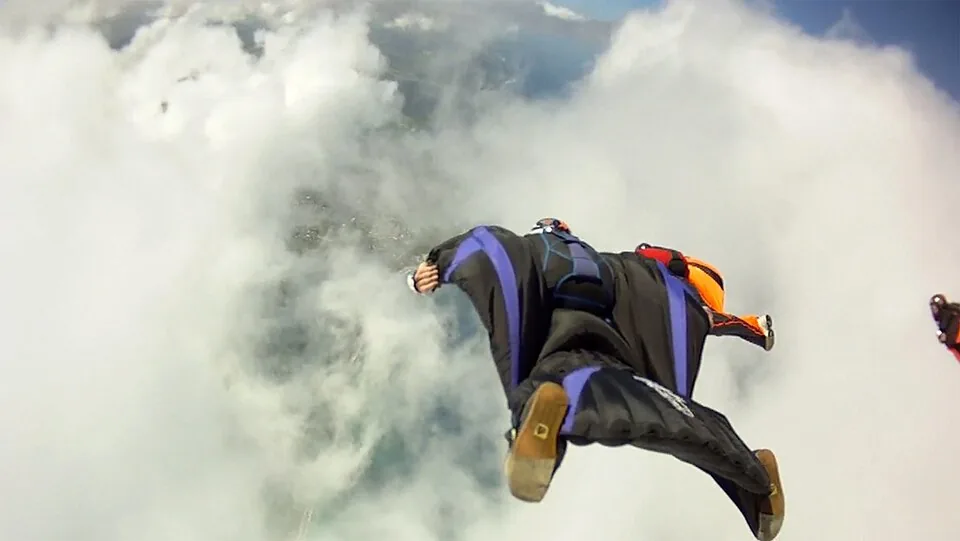
A 27-year-old BASE jumper launched himself off a 700-foot cliff in Hyrum, Utah on Sunday morning, and his wingsuit didn't do its job. Search-and-rescue crews found him dead in Leetham's Hollow at 9:10 a.m. He's the 16th BASE fatality recorded worldwide this year.
What Happened on That Cliff
Cache County Chief Sheriff's Deputy Doyle Peck laid it out plainly in a statement, as NBC News reports: "On today's jump, something went wrong and he did not have enough lift with his wingsuit. He impacted the ground at a high rate of speed resulting in his death." That sentence is doing a lot of work. Seven hundred feet is roughly the height of a 60-story building. There is not much margin for error when you step off something that tall wearing what is, functionally, a fabric exoskeleton.
The man, whose name authorities withheld pending family notification, was not a rookie. Peck confirmed he was "experienced in this type of activity" and was jumping with a group of up to ten people in the mountainous area east of Millville Canyon. This wasn't a lone daredevil doing something impulsive. This was an organized outing that turned fatal.
Leetham's Hollow, the site of the crash, sits about 45 miles north of Ogden. The canyon walls and cliffs there draw BASE jumpers regularly, Peck said. A medical transport helicopter was dispatched to assist with the search and ended up transporting the man's body out. That's a grim pivot nobody on that crew wanted to make.
The Numbers Behind the Sport
Before Sunday, the BASE Fatality List, an online community database tracking deaths in the sport going back to 1981, had logged 541 deaths worldwide. This year alone, 15 had been recorded globally before this jump. He is now number 16 for 2026.
Think about that for a second. The sport has existed in its modern, named form since photographer Carl Boenish coined the acronym BASE, standing for Buildings, Antennas, Spans, and Earth, back in 1978 after videotaping early jumps off Yosemite's El Capitan. In nearly five decades, the cumulative death toll sits at 542. That's not a rate that inspires easy comfort, but it's also not the carnage you might expect given that the core activity involves throwing yourself off fixed objects and trusting physics and fabric to keep you alive.
Utah has had a particularly brutal year for the sport. In June, NBC News reported that two BASE jumpers died in a separate accident in the state. One of them was Andy Lewis, who had performed onstage with Madonna at the 2012 Super Bowl halftime show. Two fatal accidents in the same state within three months is the kind of pattern that tends to generate calls for regulation, whether anyone in the BASE community wants to hear it or not.
The Wingsuit Problem
Wingsuit BASE jumping is a specific and particularly unforgiving subset of an already extreme sport. A standard BASE jump from a fixed object gives you very little altitude to work with compared to skydiving. Add a wingsuit, which is designed to generate horizontal lift and let you glide rather than freefall, and you're adding another mechanical variable to an equation that already has almost zero tolerance for failure.
The deputy's statement that the jumper "did not have enough lift" suggests the suit itself either malfunctioned, deployed incorrectly, or encountered conditions that negated its performance. The investigation is presumably ongoing, but Peck's public statement did not indicate any additional details about what specifically went wrong. From a 700-foot launch point, the window between something going wrong and the ground is measured in seconds.
Who Does This and Why
The group of up to ten people present at the jump site tells you something important. BASE jumping, and wingsuit jumping especially, tends to attract people who are deeply embedded in a community built around shared risk, meticulous preparation, and a specific kind of calculated bravery. These are not thrill-seekers in the casual sense. The learning curve is steep, the equipment is expensive, and the culture generally demands a long progression through skydiving before anyone approaches a fixed object.
That context doesn't make the death less tragic. If anything it makes it more so. This was someone who had put in the work, earned the trust of a group of experienced jumpers, and still ended up as a statistic on a list that now runs to 542 entries. The sport's defenders will note that people die driving to work. The sport's critics will note that nobody requires a car to freefall from a canyon wall. Both of those things are true, and neither one brings anyone back.
The Dingo Take
You are supposed to look at a story like this and see only personal choice, personal risk, personal consequence. And look, there's something to that. The man was an adult. He was experienced. He was part of a community that understands the stakes better than anyone observing from the outside. Nobody dragged him to the edge of that cliff.
But here's what sticks: Utah has now had two fatal BASE jumping incidents in less than three months, in a state where the sport has carved out popular and largely unregulated territory across its canyon country. The area around Hyrum is described as popular with BASE jumpers. Popular means regular. Regular means a pattern. At some point, authorities in these areas are going to have to decide whether "popular" also means "managed," or whether the current arrangement, where search-and-rescue crews respond after the fact and medical helicopters transport bodies out of canyons, is just the accepted cost of doing business.
That's not an anti-BASE jumping argument. That's just arithmetic. Sixteen deaths globally this year. Two in Utah specifically. A sport with a 45-year cumulative death toll now over 500. None of that demands prohibition. It does demand a conversation that goes beyond condolences and a line on a list.





Comments