
NATO's top military commander stood in Warsaw on Monday and promised to destroy "anything and everything" that supports a Russian attack on allied territory. Meanwhile, the American president whose country anchors that alliance spent the weekend announcing a diesel deal with Vladimir Putin and a waiver of certain sanctions on Russian energy exports. Pick a lane, folks.
Block, Blunt, Break: The Gen. Grynkewich Doctrine
US Air Force Gen. Alexus Grynkewich, NATO's supreme allied commander in Europe, laid out his "theory of victory" at the Warsaw Security Forum, reported by the New York Post. It comes in three parts. Block the initial attack. Blunt it if it keeps coming. Break the enemy's forces if required.
He was not subtle about the scope. "This includes not just the attacking force itself, but anything and everything that supports, sustains, and controls that force," he said. That is a general telling you the target list is long and the logistics tail is on it.
He also called NATO a "lethal alliance," which sounds like a branding exercise from a firm that also makes energy drinks. Still, the message was clear enough. "If someone is foolish enough to attack us, we will fight," he said, adding that any attack on any ally would prove "utterly futile."
The Unnamed Adversary Everyone Can Name
Grynkewich never said the word "Russia" in his address. He didn't have to. The panel was literally titled "Theory of Victory: How Do We Achieve Military Success Against Russia in Deterrence and Defence?"
This is the diplomatic version of announcing "I will be very upset with whoever keeps eating my yogurt" while staring directly at one specific roommate. NATO's 2022 Strategic Concept already names Russia as the most significant and direct threat to allied security, so the omission was a courtesy and nothing more.
The backdrop matters. European governments have accused Moscow of running a hybrid warfare campaign of sabotage, arson, and cyberattacks. In 2025, multiple Russian drones crossed into Polish airspace during a large-scale attack on Ukraine, and NATO launched Operation Eastern Sentry to shore up the eastern flank. Romania has reported drone incursions. Estonia has accused Russian military aircraft of violating its airspace.
Moscow Keeps Mentioning Nukes, Casually
On Sept. 30, Russia sent NATO a diplomatic note, obtained by Reuters, warning that it could use nuclear weapons if the alliance tried to isolate Kaliningrad. That's the heavily militarized Russian exclave wedged between Poland and Lithuania.
The note accused NATO of pursuing a "dangerous and reckless course" that carried "high risks of the outbreak of a direct armed conflict." It also floated the possibility of strikes against decision-making centers in NATO countries at the outset of a conflict. Read that again. Decision-making centers. As in capitals.
NATO Secretary-General Mark Rutte shrugged it off. "Putin knows that he can never win from NATO," he said. Putin, for his part, keeps insisting Russia has no plans to attack European countries and wants peaceful coexistence with its neighbors. This is the same man whose drones keep wandering into other people's airspace by what we are apparently meant to believe is a series of unfortunate navigation errors.
Meanwhile, in Washington, a Sanctions Waiver
Here is where the whole thing gets weird. Grynkewich's speech came after a weekend in which Russia launched fresh strikes on Ukrainian energy infrastructure despite ongoing diplomatic efforts to reduce hostilities. Zelensky accused Moscow of continuing to hit energy facilities, which does not exactly scream ceasefire.
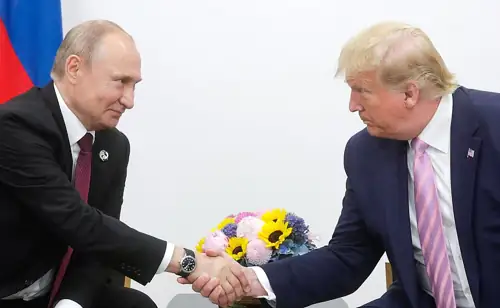
And also over that same weekend, President Trump announced he had reached an agreement with Putin to increase Russian diesel supplies to the US and global markets. The reported deal includes a waiver of certain US sanctions on Russian energy exports.
So the sequence goes like this. Russia bombs Ukraine's energy grid. America relaxes sanctions on Russia's energy exports. A NATO general then flies to Warsaw to promise Russia a very bad time if it tries anything. If you're keeping score at home, one arm of the Western alliance is flexing while another is writing Moscow a discount coupon.
'I Felt the Love' and Other Reassurances
Grynkewich also had to address the elephant that follows Trump into every NATO room. The president has pressed European allies to spend more on defense and has questioned whether countries that don't meet their obligations should expect US protection.
The general's answer was to reach back to the 2025 NATO summit in The Hague. "I was in the room and I felt the love," he said. That is a quote from a four-star general, offered as evidence of the strength of the transatlantic security guarantee. Somewhere, a Baltic defense minister read that line and quietly poured a large drink.
To be fair, he followed it with something firmer. "What I want to do is assure the one billion citizens of our alliance that we've got this," he said. "If attacked, we are ready to fight tonight, but we are not complacent." He also said he's willing to discuss suspected hybrid attacks more openly if member governments ask him to.
The Dingo Take
You are being asked to believe two things at once. One is that the most powerful military alliance on Earth is fully united and ready to flatten anyone who attacks it. The other is that the alliance's biggest member is simultaneously loosening sanctions on the country everyone is bracing against. Both of those cannot be the whole story.
Deterrence only works if the other side believes you. Putin has a front-row seat to a US president who muses about whether allies deserve protection, who cuts energy deals while Russian missiles hit Ukrainian power plants, and whose own general had to cite a warm feeling in a conference room as proof of commitment. That is not a credibility strategy. That is vibes.
Grynkewich sounds like he means every word, and the military planning behind "block, blunt, break" is presumably serious. But a doctrine is only as strong as the political will behind it, and right now the political will is sending Moscow diesel invoices. A general can promise to break an enemy's warfighting system. He cannot promise that the White House will let him.


Comments