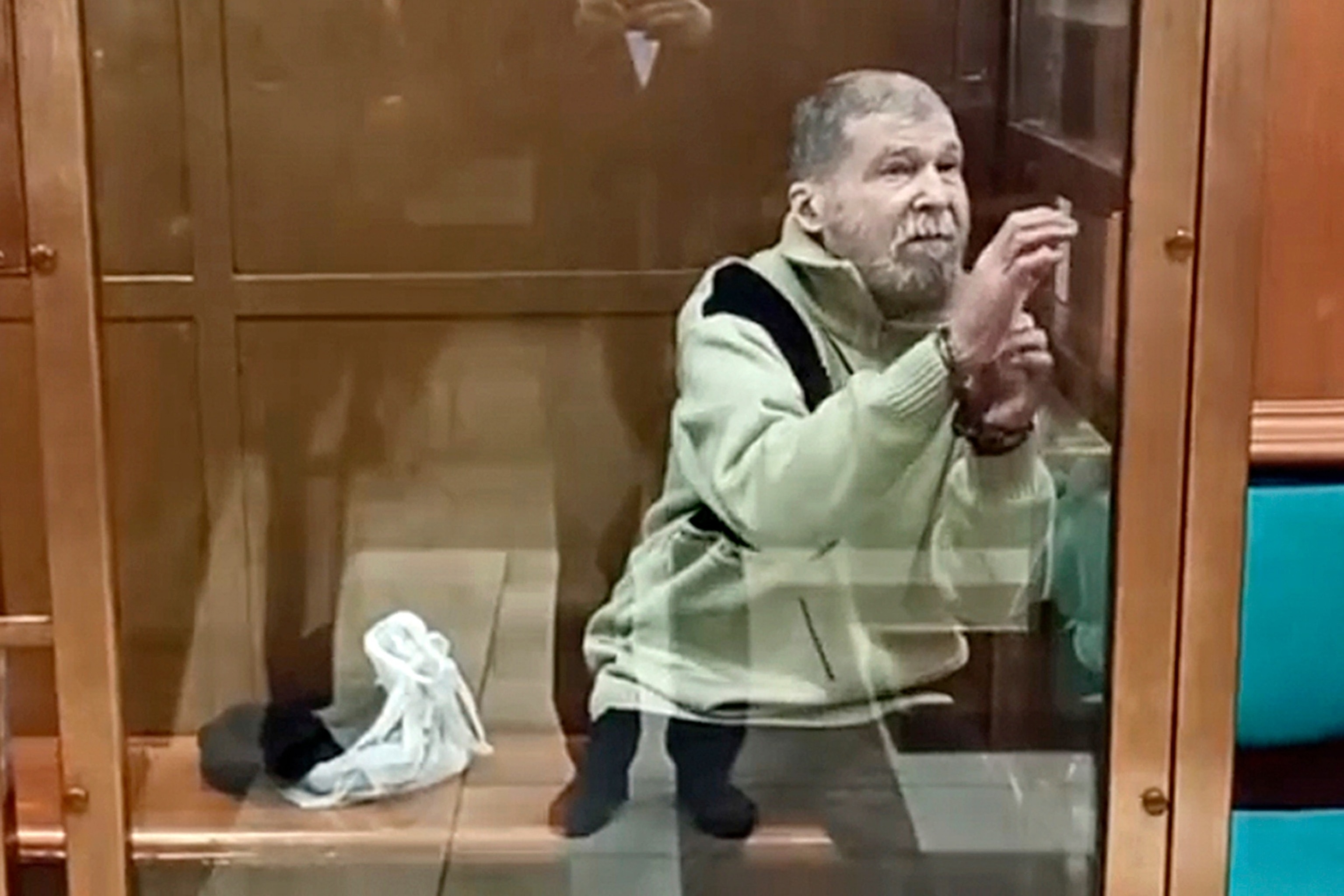
Russia released 74-year-old American teacher Stephen Hubbard on Wednesday, and President Trump promptly announced that the United States gave up absolutely nothing to get him. That claim lands a bit awkwardly when you remember that Trump waived sanctions on Moscow just last week, and then admitted in a follow-up post that enforcing them would have killed the release talks.
A Handshake In St. Petersburg
Hubbard walked free as White House envoy Steve Witkoff sat down with Vladimir Putin in St. Petersburg to discuss ending the war in Ukraine. According to NBC News, Witkoff thanked Putin on camera for the release, and Putin obliged by announcing that Hubbard was already waiting at Pulkovo Airport. Witkoff later met with Hubbard at an undisclosed location.
Russian state news agency Ria filmed the encounter. Hubbard, in a green jacket and smiling, shook Witkoff's hand and said, "Thank you very much for all your efforts." Witkoff told him Putin sent his "blessings," and added, "from today, it's a new life."
Pause on that. The American envoy relayed the blessings of the man whose army invaded the country where this teacher lived. It was a warm little moment, staged for cameras, and the cameras belonged to the Kremlin.
Nothing In Return, Except The Part Where There Was Something
Trump announced the news on Truth Social, writing that "the United States, out of respect for President Trump, was not required to give anything in return," and calling it "an unprecedented situation for Russia." He added that no "swap" was necessary.
Then came the second post. Trump said those negotiations "would have come to a complete and total halt" if the U.S. had gone ahead with the sanctions he waived last week. So the sanctions were a thing, they were waived, and the talks would have died otherwise. That is not nothing. That is, in plain English, the price.
NPR's account is blunter about the backdrop. Hubbard's release came as Trump has lifted some sanctions on Moscow and openly criticized Ukraine while pushing to negotiate an end to the war. You can call it a favor, a gesture, or a humanitarian move. You cannot call it free.
Who Stephen Hubbard Actually Is
Hubbard is a retired educator from Big Rapids, Michigan, who served in the Air Force and National Guard, according to military records cited by The New York Times in 2025. He lived in Japan and then Cyprus before moving to Izyum, Ukraine, in 2014. His sister, Patricia Hubbard Fox, told Reuters she last spoke with him in September 2021.
Russian forces captured him in April 2022, about two months into the invasion, while advancing on Izyum. Russian prosecutors claimed he signed a contract with Ukraine's military, joined a territorial defense battalion, received training, weapons and ammunition, and was promised $1,000 a month. State media claimed he manned a Ukrainian checkpoint and pleaded guilty.
His lawyer, Martin De Luca, told Reuters the charges were false and that Hubbard had no involvement with Ukraine's military and was simply detained at a house in Izyum. His sister said he held pro-Russian views, was unlikely to take up arms at his age, and questioned the reported guilty plea. The trial, held behind closed doors in 2024, produced almost no public evidence. He was sentenced to nearly seven years.
The Kremlin Calls It Humanitarian
Kremlin spokesman Dmitry Peskov said Putin freed Hubbard "on humanitarian grounds," without elaborating. Hubbard's family went further. His son, the Rev. Joseph Coleman, an Orthodox priest, said in a statement that the family "must acknowledge that this humanitarian move by President Putin in this matter is deeply appreciated."
Hard to blame them. They spent years terrified for a man in his seventies sitting in a Russian prison, and they got him back. A family in that position thanks whoever opens the door. Nobody should lecture them about it.
But the rest of us can notice what the thank-you note reveals. The government that held him for four years, on charges his own lawyer calls false, is now collecting gratitude for letting him go. The hostage-taker gets to play the benefactor. Putin got the photo op, the on-camera thanks from a U.S. envoy, and a sanctions waiver he did not have to earn.
The Marc Fogel Pattern
This is the second release of this kind. Russia freed teacher Marc Fogel in February, after he served part of a 14-year sentence for allegedly trying to enter Russia with medical marijuana in 2021. National security adviser Mike Waltz said at the time that Fogel's release "serves as a show of good faith from the Russians and a sign we are moving in the right direction to end the brutal and terrible war in Ukraine."
Both men had been designated wrongfully detained under the Biden administration. Fogel's sister said her family felt "stabbed in the back" when he was left out of the massive prisoner swap that freed journalist Evan Gershkovich, the largest exchange of detainees since the Cold War. Hubbard, according to his lawyer, is now the only American in Russia currently carrying that State Department designation.
So the pattern is clear. Americans get released one at a time, each release comes wrapped in praise for Putin's good faith, and each one arrives alongside a softening of U.S. posture toward Moscow. Meanwhile, The Hill notes Republican senators are already unhappy about Trump's warming relationship with Putin.
The Dingo Take
In the 1980s, the Reagan administration sold missiles to Iran and swore up and down that it wasn't trading arms for hostages, right up until the paperwork said otherwise. The denial was part of the deal. Trump's version is slicker and faster: announce that nothing was given, then admit in the next post that the talks would have collapsed without the sanctions waiver. That's not a denial. That's a receipt.
Here's what matters. A 74-year-old man is going home, and that is a good thing, full stop. His family is relieved and nobody should take that from them. But a good outcome doesn't make the arithmetic honest. If freeing one teacher costs Washington its leverage over a country that is still bombing Ukrainian cities, then Moscow just learned that taking Americans works. Every future detainee in a Russian cell is now a bargaining chip with a known exchange rate.
Trump called it unprecedented for Russia to give something without getting something. Sure. And I have a bridge in Michigan to sell you, and I'll throw in a sanctions waiver for free.
Comments