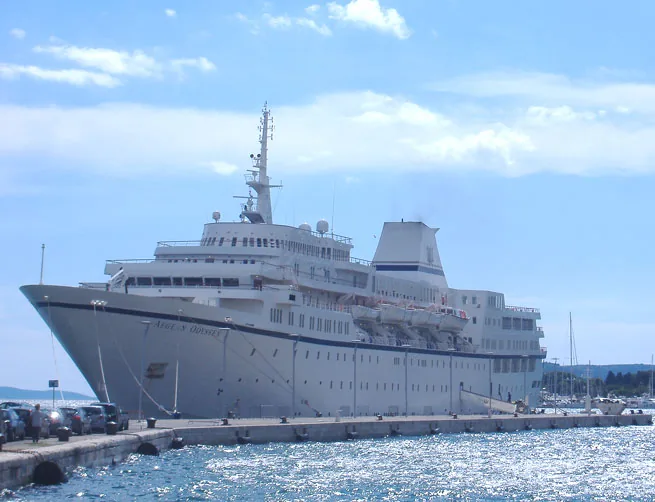
More than 200 passengers, mostly Americans, are stranded in Cambodia after the operator of a never-ending around-the-world cruise ran out of money. Some of them sold their houses to live on that ship forever. They were given a 15-year residency guarantee, and they got it for about a year and a half.
Forever Lasted Until Tuesday
Villa Vie Residences, the Florida company behind the MV Odyssey, suspended operations on Tuesday and told passengers to pack. One of them, retiree Benjamin Schatz, was given just hours to gather his life and get off the ship, according to CBS News. CBS first met him in April 2025, a year into his new life at sea. He told the network he is in denial, in shock, and heartbroken.
The Odyssey launched in October 2024 as a continuous round-the-world voyage with no end date, which was the whole pitch. You could become a resident by buying a permanent cabin for several hundred thousand dollars. Some buyers sold their homes to do it. The company gave them a 15-year minimum guarantee of residency aboard.
Fifteen years. Let that sit for a second, because the actual number turned out to be roughly two.
The Math That Sank the Ship
CEO Mikael Petterson walked through the numbers in a phone interview, and they are ugly. Before the war with Iran broke out in late February, the Odyssey paid an average of $700 a ton for fuel. Since then it has paid between $2,000 and $3,000 a ton. The ship burns 700 to 800 tons a month.
Do that multiplication and watch your stomach drop. Monthly expenses went from $400,000 to $2 million. Per-cabin fuel costs went from an average of $1,800 a month to somewhere between $6,000 and $8,000. "Where are we going to get the $1.6 million?" Petterson asked. Nobody had an answer, and that was the end of the voyage.
The company says it refused to pass those costs on to passengers. That is either admirable or a sign of a business model with no shock absorbers. Possibly both.
Slow Boat to Nowhere
The Odyssey's strategy for surviving the price spike was to slow down. The ship started spending five or six days in each port, burning less fuel and, in Petterson's words, "hoping that things would come to a close in the Middle East."
Hoping. That was the plan. For nine months, a company responsible for more than 300 people and the life savings of many of them was steering by optimism and a fuel gauge. The Middle East did not oblige.
Petterson says the company borrowed money and stretched its payrolls as far as they would go. Eventually it hit what he called a breaking point where it needs capitalization. In normal English, that means it ran out of cash while searching for a financial partner who never materialized.
Chapter 11 and Nowhere to Land
The plan now is to file for Chapter 11 bankruptcy. That is a legal process designed to sort out creditors and keep a business alive, and it does not do much for a retiree standing on a dock in Cambodia with a suitcase and no address.
Schatz put the human cost plainly: "There are people now who are homeless and who have very little money and don't know what they're going to do." Remember that some of these residents sold their homes to buy in. Their house is gone. Their cabin is gone. The ship is stuck in port, and they are on the wrong side of the gangway.
The passengers did nothing reckless by the standards of the pitch. They bought a product that promised permanence, and the product depended entirely on a fuel price that a war just quadrupled.
The War Has a Bar Tab Too
We tend to talk about the Iran war in terms of strategy, deterrence, and whatever the administration is calling it this week. We talk much less about the nine-month bill that lands on ordinary people who were nowhere near the decision. A retiree on a cruise ship is about as far from a policy debate as a person can get, and the war still found him.
This is what a fuel shock looks like when it hits a business with no margin and a customer base with no safety net. It does not arrive as a headline about oil markets. It arrives as a notice to pack your things in a few hours.
The Dingo Take
"When you divide it over 300 people on board, it's just backbreaking." That is the CEO describing a fuel bill that went from $400,000 to $2 million a month, and he is right. What he skipped is the part where the people holding the bag are the ones who sold their houses on a 15-year promise.
Look, a business that sells permanent homes on a floating hotel with razor-thin margins and no real plan for a fuel spike is taking a gamble with other people's retirements. That deserves scrutiny, and the bankruptcy process should treat these residents like the people they are, not like unsecured line items. But the deeper insult is upstream. Somebody chose a war, somebody else gets to say it will all come to a close soon, and the bill shows up on a dock in Cambodia.
Nobody in Washington will ever have to explain this to Benjamin Schatz. He gets to explain it to himself, in a strange country, with a suitcase, wondering how a forever home lasted less than two years.





Comments