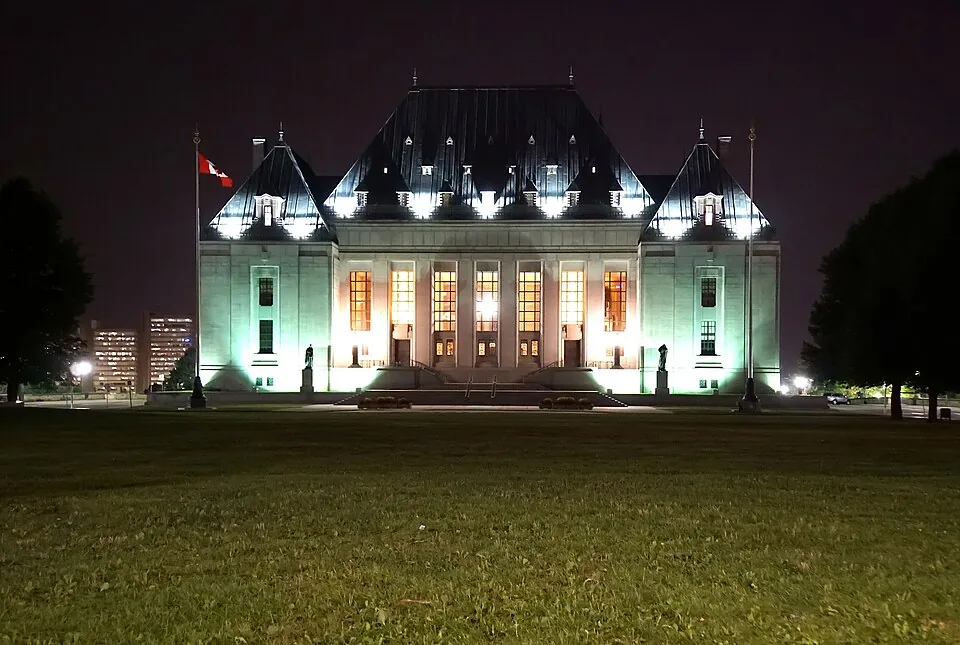
Canada's Supreme Court just ruled that a province can bar teachers, police officers and other public employees from wearing hijabs, turbans, kippahs and crosses on the job, and that courts basically have no business telling it otherwise. The 500-plus page decision, reported by the South China Morning Post and others, upholds Quebec's Bill 21 in almost every way that matters. The one thing the court protected was the right of elected politicians to cover their faces in the legislature, which is a hell of a priority list.
Explain Like I'm 5 · 45-second video

Narrated and captioned. Made by The Dingo Daily from this article.
The Ruling, In Plain English
On Friday, the seven-justice court largely upheld Bill 21, the 2019 law that bans certain public workers from wearing religious symbols at work. That covers public school teachers, police officers, judges and some other officials. The court found Quebec used the notwithstanding clause lawfully, both when it passed the law in 2019 and when it renewed it in 2024.
There was one exception. The court struck down a separate rule requiring elected members of Quebec's National Assembly to uncover their faces, finding it infringed their democratic rights. So the ban on a teacher wearing a hijab in a classroom stays. The ban on a legislator wearing a face covering in the legislature does not.
The court also said something that reaches far beyond Quebec: "It is not open to the courts to place additional limits on the exercise of the override power." Read that twice. That is the highest court in the country telling itself to stay out of the way.
What The Notwithstanding Clause Actually Is
Quick primer for anyone who does not follow Canadian constitutional law for fun. Section 33 of the Charter of Rights and Freedoms lets federal and provincial governments keep a law in force even if it violates certain rights, including freedom of religion and equality rights. The override lasts up to five years and can be renewed. In theory, forever.
It was born in the early 1980s as a "grand bargain" to get the provinces to sign onto a rights charter at all. Some of them worried unelected judges would end up with more power than elected legislators. The clause was supposed to be a safety valve, a last resort.
A last resort is not what it is anymore. Quebec used it for Bill 21, then again to widen the restrictions to school support staff and volunteers under Bill 94 and to daycare staff under Bill 9. Saskatchewan used it for legislation affecting LGBTQ youth, specifically parental consent before students under 16 can change their names or pronouns. Alberta used it to impose a collective agreement on teachers. Ontario's Doug Ford threatened to use it over the size of Toronto's city council. As Stephen Brown of the National Council of Canadian Muslims put it, "It was intended to be an instrument of last resort, and now it has become an ordinary instrument of government."
Three Justices Said The Quiet Part Out Loud
The decision was not unanimous in spirit. Chief Justice Richard Wagner, writing for three justices, said Bill 21 is rooted in Quebec's "legitimate and historical commitment" to keeping the state secular. Three other justices, Andromache Karakatsanis, Michelle O'Bonsawin and Nicholas Kasirer, argued the notwithstanding clause "cannot be used to authorize laws that are incompatible with the fundamental character of Canada as a free and democratic country." They believe the law infringes freedom of religion, freedom of expression and the right to equality.
Four of the seven justices also agreed that judges can formally declare that a law violates Charter rights even when the notwithstanding clause keeps it alive. That declaration would not strike the law down, but it would "vindicate affected individuals" and tell citizens how their rights are being overridden by their own representatives.
Only three justices wanted to issue such a declaration in this case. So the court issued none. The door is open for future cases, and it is firmly closed for the people living under this one.
What The Law Does To Actual People
Nevien Waly volunteered at her kids' schools for a decade. Bake sales, graduation committees, the whole parent-volunteer routine. She started wearing the hijab at 40. Then she got an email saying that under Bill 94, parents who wear religious symbols can no longer volunteer. She told Al Jazeera it felt like a "slap in the face," and that she struggled to answer when her younger kids asked what she had done wrong. "I'm the same person I was 10 years ago," she said.
She left a finance career to train as a specialised educator and was supposed to start work next year. Now she says she cannot do the job she trained for as long as she wears the hijab. She expected the court to uphold the law but said she was holding out hope. "I'm sad for myself, worried about the future of our kids."
The numbers back her up. A 2022-2023 survey of 411 Muslim women for a report by the NCCM and York University researcher Nadia Hasan found that 73 percent said Bill 21 had affected their job search, and 48 percent believed they were passed over because of their religious identity. Some women take the hijab off at work and put it back on after, a routine Brown said people described to him as humiliating. And 88 percent said the law made Quebec a less welcoming place to live.
Where This Is Headed Next
Quebec is not done. The government has said it wants to go further and bar elementary school students from wearing religious symbols. Earlier this year it expanded secularism rules to subsidised daycares and post-secondary institutions, and it restricted public prayer with fines for non-compliance. Every one of those expansions leans on the same override the court just blessed.
Premier Paul St-Pierre Plamondon celebrated the ruling as a victory for Quebec's distinct approach to secularism, saying, "We worried about social peace if such a fundamental choice were to be invalidated by the Supreme Court." Bloc Québécois leader Yves-François Blanchet said the province is now "more than ever in a position to move forward" on preserving what defines Quebec society. Alberta Premier Danielle Smith, whose government intervened in the case, called it "a win for provincial rights" and said elected legislatures should have the final say.
The politics are messy for the federal government too. The ruling is a win for Quebec's sovereigntist movement at exactly the moment Prime Minister Mark Carney is trying to hold the country together against a trade war and annexation threats from Donald Trump. Carney told the CBC that Ottawa is "carefully studying" the 500-page ruling and that all legislatures should "respect the rights of all Canadians, including those in the minority."
The Groups Who Lost Are Not Pretending Otherwise
The NCCM called it "a dark day in our constitutional democracy." Brown said that "entire categories of people are now barred from entire sectors of employment, not because of what they have done, but because of who they are." He also warned the ruling hands every government in the country an "unrestricted licence" to take away fundamental freedoms, and urged Ottawa to talk to the provinces about limiting the clause.
The Canadian Civil Liberties Association found a sliver of comfort, saying the ruling "sends a message that even shielded laws cannot escape scrutiny entirely." Then it added the part that matters: "But for the people this law affects every day, that door remains closed." The English Montreal School Board, another challenger, said it was "obviously very disappointed" but took solace from some of the court's declarations.
The law's defenders insist it is neutral because it covers every faith. Technically true. It bans the cross too. But a survey where nearly half of Muslim women believe they lost a job over their religion, and a hijab-wearing mother getting emailed out of the school bake sale, tell you who is actually paying for the neutrality.
The Dingo Take
Quebec says Bill 21 is about neutrality, and the Supreme Court just agreed it is neutral enough to keep. The facts say otherwise. A law that is neutral on paper, applied to a province where a woman gets told she cannot volunteer at a bake sale and another takes her hijab off in a parking lot before her shift, is not neutral in practice. It is a law whose costs fall overwhelmingly on one group of people, and everyone involved knows which one.
Here is the part that should bother Canadians outside Quebec. The court did not just bless one province's secularism. It told the courts to stay out of the override business. Section 33 was sold as a rare safety valve and has turned into a convenience store. Quebec used it on religion. Saskatchewan used it on trans kids. Alberta used it on striking teachers. Alberta's premier is already cheering, which tells you exactly who plans to shop there next.
The three dissenters said a free and democratic country cannot authorize laws incompatible with its own character. That is the sentence worth remembering. Four of seven justices said courts can at least name a rights violation out loud. Then the court declined to do it anyway, leaving Nevien Waly with a decade of bake sales behind her and a career she trained for that she still cannot start. The rights stay on the books. She just cannot use them.




Comments