Women make up 3% of Kenya's accredited construction artisans. Not because they can't do the work. Because nobody ever trained them, paid them fairly, or told them the door was open. A Nairobi nonprofit called Buildher decided that was a solvable problem, and so far, more than a thousand women later, it looks like they were right.
The Number That Says Everything
According to Kenya's National Construction Authority, women account for just 3% of the country's accredited construction artisans. Three percent. In a sector that NPR describes as a multi-billion-dollar industry, driven in large part by a frenetic building boom across Nairobi.
The women who do work construction in Kenya aren't typically the ones running tile saws or supervising carpentry installations. They carry water. They haul sand. They clean sites. They get the informal, lower-paid, dead-end work while the skilled trades jobs, the ones with actual earning potential, go almost entirely to men.
This isn't a coincidence. It's the result of assumptions so baked into the culture that many women, as Buildher cofounder Tatu Gatere told NPR, simply can't see the opportunity sitting right in front of them. "I had seen women get stuck in low-paying jobs, and it was like a mental barrier where they couldn't see the potential right in front of them," Gatere said. "So I wanted to help women see that."
What Buildher Actually Does
Gatere is an architect, and in 2019 she cofounded Buildher, a Nairobi-based nonprofit that runs year-long training and internship programs in carpentry, tiling, painting, and other finishing trades. This year, according to NPR, the organization expanded into solar installation. The goal is straightforward: give women the technical skills to access steadier, better-paid work in a booming sector that has been actively ignoring them.
The results, at least on paper, are hard to argue with. Buildher says it has trained more than 1,000 women since its founding. Graduates go from earning an average of about $1.50 a day to between $11 and $12 a day within a year of completing the program. That's a five- to sixfold increase in daily earnings for women who were previously locked out of skilled work entirely.
A 2024 study by Dalberg, a global development advisory firm, found that roughly 65% of Buildher graduates were still working in construction 12 months after finishing the program. That's a retention number that a lot of workforce development programs in wealthy countries would kill for.
Meet the Women Actually Doing This
NPR's Christopher Clark visited Furniture International, a cabinet manufacturing company on the outskirts of Nairobi, where several Buildher graduates now work. Diana Ojiambo, 24, is a machine operator there, feeding cabinet panels through a PVC edger amid a mostly male workforce. A year ago she had never worked in the industry. She had never worked alongside men before.
Ojiambo is a single mother of two who was unemployed and living in Kibera, one of Nairobi's largest informal settlements, when a friend told her about Buildher. "My life was so challenging," she told NPR. "But now I can support myself, I can support my kids." Within the next year, she plans to open her own carpentry business in Kibera.
Also at Furniture International is 23-year-old Jane Mwangi, who now works as a supervisor, moving between stations and checking measurements less than a year after entering the industry for the first time. These aren't anomalies. They're what the program was designed to produce.
The Barriers Go Way Beyond Job Skills
Here's the part that makes this harder than just teaching someone to lay tile. Gatere told NPR that for many of the women arriving at Buildher, learning the trade is only one piece of the puzzle.
They arrive carrying childcare responsibilities, financial instability, and in many cases active resistance from husbands or parents who are uncomfortable with women doing construction work at all. Some have never been in a male-dominated workplace and carry legitimate fears about harassment, which NPR reports is often rife in the sector. Gatere has firsthand experience with that, having spent her career as an architect in an industry that does not exactly roll out the welcome mat for women.
Buildher's approach to this isn't purely technical training. Much of the organization's growth has come through word of mouth, as graduates tell friends and neighbors what's possible. Gatere told NPR that simply hearing about other women succeeding in the trades can shift what feels achievable. Sometimes that's all it takes. Proof of concept, walking around in a blue bandana, operating a PVC edger.
What This Looks Like on the Ground
NPR's reporting puts you inside the training center at Spectrum Business Park in Nairobi's Baba Dogo industrial area, a network of warehouses where new intakes of students learn to lay tile, use power tools, and eventually go out into an industry that never expected them.
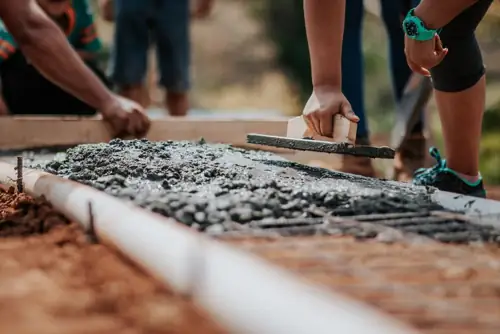
On a recent morning, 16 trainees sat in on an introductory solar installation presentation while, next door, another group practiced spreading tile adhesive on a concrete floor, dragging notched trowels through it under the direction of trainer Robert Ndungu. They scrape it back, and they start again. "These women come here knowing nothing about tiling," Ndungu told NPR. "By the end of this training, they are able to work, earn money and improve the life of their family."
That's the loop. Learn it. Earn from it. Tell someone else.
The Dingo Take
The story NPR is telling here is genuinely good news, which we don't get to say often enough. A woman with an architecture degree looked at a broken system, started a nonprofit in 2019, and seven years later more than a thousand women are making real wages in an industry that used to hand them a bucket of water and call it a job. That's not a feel-good sidebar. That's a structural intervention that is actually working.
What gets you is the math. Going from $1.50 a day to $11 a day doesn't sound revolutionary until you remember that $1.50 a day is the math of survival without a cushion, without savings, without options. It's the math of Diana Ojiambo unemployed in Kibera, trying to raise two kids. And $11 a day, while still modest, is the math of planning. Of thinking ahead. Of saying out loud that you want to open your own carpentry business, because now that doesn't sound insane.
Kenya's construction sector is worth billions. Women build in it, clean it, support it, and raise the children of the men who dominate it. Buildher is handing some of those women a tile saw and a paycheck and saying: the door was never actually locked, it just wasn't labeled for you. More of this, please. Everywhere.



Comments