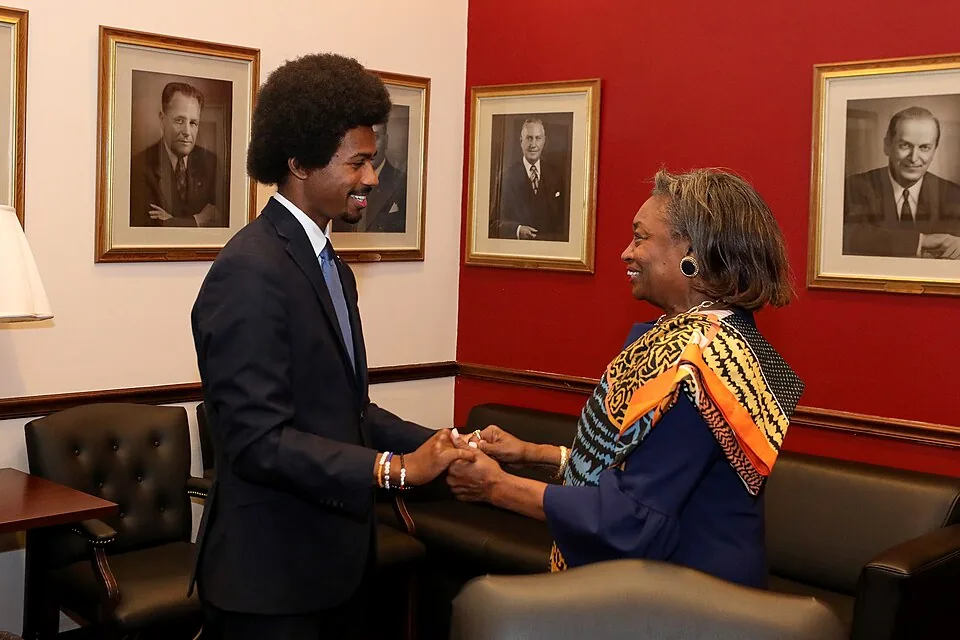
Justin Pearson got expelled from the Tennessee state legislature for protesting gun violence. Three years later, he just won a Democratic congressional primary in a district the Trump administration literally carved up to dilute Black voting power. If the establishment wanted to bury this guy, they are going to need a bigger shovel.
Who Is This Guy, Exactly
At 31, Pearson has already packed in enough fights for three political careers. Before he was a state lawmaker, he was organizing against a crude oil pipeline being routed through Black neighborhoods in Memphis. Before that, he was in school fighting to get his classmates actual textbooks. The Guardian profiles him this week as one of a new wave of progressive-populist candidates sweeping primaries across the country, and the bio reads less like a political resume and more like a list of things the powerful tried to do to one community and failed.
Then came the gun protest. In 2023, Pearson and two colleagues took to the state house floor to demand gun control legislation after a deadly school shooting. Tennessee Republicans responded by expelling them from the legislature. It backfired spectacularly. Pearson was reinstated by his constituents almost immediately, became a national figure overnight, and is now running for Congress. So, good work, Tennessee GOP.
Fighting Elon Musk Before It Was Cool
Here is where the story gets specific in a way that should embarrass a lot of people who came late to the Elon Musk criticism party. Pearson has been fighting xAI's data centers in south Memphis for years. According to The Guardian, xAI built facilities powered by soot-producing turbines concentrated in a Black neighborhood already hammered by environmental damage. Pearson co-founded Memphis Community Against Pollution with his brother specifically to expose this.
The NAACP and environmental groups took the turbine issue to court. Then the Justice Department stepped in, not to help, but to argue the data center was necessary for something called Operation Epic Fury. That is a real name. The federal government intervened to protect Elon Musk's polluting infrastructure in a Black neighborhood, and they named the operation like it was a Transformers sequel.
Pearson told The Guardian the throughline is not complicated: "Who profits off of war are the same people who are profiting off of polluting our communities and stealing our drinking water for their datacenters that replace our jobs." That is a fairly clean theory of the case, and it is landing.
The Trump Taskforce Nobody Asked For
Memphis has also been on the receiving end of one of Trump's signature urban intervention projects. Last September, Trump stood up a Memphis "taskforce" pulling in 13 federal agencies and flooded the city with hundreds of federal agents. His stated reason was that Memphis was drowning in violent crime. The week before he said this, according to The Guardian, local Memphis police had celebrated overall crime hitting a 25-year historic low.
In the ten months since the taskforce launched, federal agents have killed four Black men in Memphis. In July, more than 1,000 people showed up to a Pearson rally in response. Alexandria Ocasio-Cortez, Summer Lee, and Ayanna Pressley were there. The math on this is not subtle: Trump sent agents, agents killed people, people went to a Pearson rally. Whatever outcome the taskforce was designed to produce, it seems to have produced a congressman.
The Map Was Rigged and He Won Anyway
Tennessee's ninth district used to be the state's only majority Black congressional district. After the Supreme Court gutted the second provision of the Voting Rights Act, the Trump administration helped redraw the map, splitting the district into pieces. The Guardian describes this explicitly as part of a broader effort to retain congressional control and dilute Black voting power in the South.
Pearson won the Democratic primary in this reconfigured district running on Medicare for All, ending what he calls genocide, and taking on billionaires who own data centers. His average campaign donation was $31. He was endorsed by Bernie Sanders and Justice Democrats, the group that originally sent Ilhan Omar, Ayanna Pressley, and Rashida Tlaib to Congress. David Hogg's progressive PAC, Leaders We Deserve, was on board from day one.
The Bigger Pattern
Pearson is not alone in this moment. The Guardian places him alongside Michigan's Abdul El-Sayed and New York's Darializa Avila Chevalier and Claire Valdez as part of a wave of young organizing-first candidates modeled on the campaign playbook that got Zohran Mamdani elected mayor of New York in 2025. Small donors, deep community roots, unambiguous positions on things the party establishment prefers to hedge.
The establishment hedging is, apparently, not going over well. "These primaries have shown voters of all ages are ready for next-generation leadership, and are more than willing to challenge the aging Democratic establishment," Hogg said. Pearson held a rally in Pulaski, Tennessee, which is the birthplace of the Ku Klux Klan, and drew a crowd. Whatever the DC consultants are modeling, it does not appear to account for what is actually happening on the ground.
The Dingo Take
You are supposed to believe that a 31-year-old Black progressive running on Medicare for All and anti-data center environmentalism in a freshly gerrymandered Tennessee district is too radical to win. The Democratic establishment has been selling that story for a decade. It keeps not being true, and they keep telling it anyway.
What Pearson's primary win actually demonstrates is something the party's professional class finds genuinely threatening: that organizing beats money when the organizing is real, that voters in the South are not the monolith DC strategists pretend they are, and that being expelled from a legislature for demanding gun safety is, in fact, a better origin story than raising PAC money at a Georgetown fundraiser. The Trump administration tried to redraw the map around him. The Justice Department intervened to protect Elon Musk's turbines in his neighborhood. Federal agents killed four people in his city. He still won.
November is a different fight, and gerrymandered districts are designed to be hard. But the idea that the Democratic Party's path back to power runs through caution, triangulation, and telling its most energized voters to wait their turn is a theory that keeps losing primaries. At some point, the party might want to pay attention to what is actually working, even if the guy doing it has the nerve to say "genocide" out loud and raise money in $31 increments.





Comments