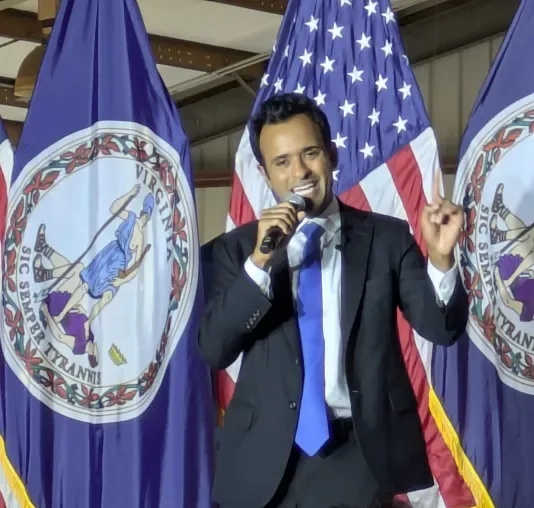
Vivek Ramaswamy, the guy who spent 2023 auditioning for a Fox News hosting slot by pretending to run for president, is now the Republican nominee for governor of Ohio. His opponent is Amy Acton, a former state health advisor who Democrats think can actually pull off a win in a state that has been reliably red for years. According to NPR, this race is being watched as a rare Democratic pickup opportunity, which is a phrase you don't get to type about Ohio very often.
How Did We Get Here
Let's do a quick recap of Vivek Ramaswamy's career trajectory, because it is something. He made hundreds of millions in pharmaceuticals. He wrote a book about how corporations are too woke. He ran for president by out-Trumping Trump at the debate podium, got absolutely nowhere, and then dropped out and endorsed Trump before anyone had even voted. Trump rewarded him with a co-chair role at the since-collapsed Department of Government Efficiency, which turned out to be less a government agency and more a brand deal for Elon Musk's grievances.
Now he wants to run Ohio. The fifth most populous state in the country. A state with a $90 billion annual budget and roughly 12 million people whose lives would be directly affected by whoever sits in the governor's mansion in Columbus. And the Republican Party said yes, this is the guy. Great pick, everyone.
Who Is Amy Acton and Why Does She Matter
Amy Acton is not a household name nationally, but she has name recognition in Ohio that most politicians would kill for. She served as Ohio's director of health under Republican Governor Mike DeWine during the early COVID-19 pandemic, and she became one of the more visible and trusted public health voices in the country during that period. She eventually stepped down in 2020 amid harassment from anti-mask protesters who showed up outside her house. You read that correctly. People picketed a public health official's home because she told them a respiratory virus was dangerous.
She is now the Democratic nominee for governor, and according to NPR, Democrats see her as a genuine shot at flipping a state that has drifted hard to the right over the past decade. Ohio went for Trump twice. Republicans hold the governorship, both Senate seats, and a supermajority in the statehouse. But something about a matchup between a trusted doctor who got harassed for doing her job and a guy who got famous for saying provocative things fast on a debate stage feels like it might scramble the usual math.
The Actual Stakes Here
Ohio's governorship is not a ceremonial prize. Whoever wins controls Medicaid policy for millions of low-income Ohioans, appoints judges, manages state emergency responses, and sets the tone for what the state does with federal funding. After watching what some MAGA-aligned governors have done with that kind of power over the past few years, the stakes feel obvious.
Ramaswamy has not exactly presented himself as a moderate caretaker type. His political brand is built entirely on being loud, being contrarian, and being willing to say the thing that makes center-right donors feel like rebels. Whether any of that translates into competent state governance is a question nobody has really had to answer yet. Ohio voters are about to find out.
Why Democrats Think This Is Winnable
NPR frames this as a rare pickup opportunity for Democrats, which deserves a moment of honest analysis. Ohio has been moving away from Democrats for years. Barack Obama won it twice. Hillary Clinton lost it. Joe Biden lost it by eight points. The structural math has not been kind.
But candidate quality matters, and so does the specific matchup. Acton is a known quantity with a record of competent crisis management in a state that remembers the pandemic. Ramaswamy is polarizing in a way that motivates opposition turnout, and his brand of culture-war performance politics plays differently in a general election than it does in a Republican primary. The theory of the case for Democrats is basically: Acton is someone Ohioans already trust, and Ramaswamy is someone a lot of Ohioans already find exhausting. That combination, plus whatever the broader national political environment looks like by November, could be enough.
What the Race Will Come Down To
Every Ohio statewide race in the modern era lives and dies in the suburbs, particularly the collar counties around Columbus, Cleveland, and Cincinnati. College-educated suburban voters, especially women, have been the most volatile part of the electorate for the past several cycles. They flipped toward Democrats in 2018 and 2020 on issues like abortion rights and democratic norms, then showed frustration with Democratic governance in 2021 and 2022. How they feel in the fall of 2026 is genuinely hard to predict.
Abortion access is almost certainly going to be central to this race. Ohio voters enshrined abortion rights in the state constitution in 2023 by a double-digit margin, even as they kept electing Republicans to everything else. That is a tension that benefits Acton, who spent her career in public health, over Ramaswamy, who will have to thread a needle between his national base and a state electorate that just voted pretty clearly on the question.
The Dingo Take
You are supposed to look at Vivek Ramaswamy and see a serious gubernatorial candidate. The guy who said the January 6th rioters were "actually victims" on a national debate stage. The guy who proposed abolishing the FBI, the ATF, the Department of Education, and several other agencies in the span of about forty minutes. The guy who made it to the semifinals of a presidential primary by being willing to say absolutely anything and then dropped out the moment actual votes were counted. That guy now wants the keys to Ohio's government. Sure. Makes total sense.
Acton is not a perfect candidate and this is not a gimme race for Democrats. Ohio is hard. The electorate has moved. The structural disadvantages are real. But there is something almost poetic about the matchup: a woman who got harassed out of public service for taking public health seriously, running against a man who built his political career on the premise that institutions are useless and experts are frauds. Voters get to make a choice about what kind of leadership they actually want.
If Democrats lose this, they lose it because Ohio is just that red now, and that's a legitimate outcome to reckon with. If they win it, it would be one of the more satisfying results in a state that has handed them heartbreak after heartbreak for a decade. Either way, this race is worth watching more closely than most people outside Ohio currently are.


Comments